We made a Caesar Salad but substituted Belgium Endive for the Romain Lettuce. It was a bad decision, we should have stuck with the tradional Romain Lettuce, the Belgium Endive was too bitter. Oh well, we tried. The soufflé was made with Parmesan Cheese that Guillermo brought us from Italy. You can get the recipe from our blog of: Feb. 15, 2013. Click the date to get the recipe.
Monday, May 25, 2015
Cheese Soufflé and Caesar Salad
We made a Caesar Salad but substituted Belgium Endive for the Romain Lettuce. It was a bad decision, we should have stuck with the tradional Romain Lettuce, the Belgium Endive was too bitter. Oh well, we tried. The soufflé was made with Parmesan Cheese that Guillermo brought us from Italy. You can get the recipe from our blog of: Feb. 15, 2013. Click the date to get the recipe.
Friday, May 22, 2015
Roasted Cauliflower Salad
We had some leftover Roasted Cauliflower from Pizzeria Mozza. It made a great salad component. Easy and delicious.
Tuesday, May 19, 2015
Cherry Salad
Cherries are at their peak. We made a Salad with Cherries and Cheese to go with our leftover Lasagna. A cherry pitter is necessary kitchen utensil.
Friday, May 15, 2015
Slow Cooked Salmon
We found this excellent recipe for Slow Cooked Salmon in The Los Angeles Times. You can find the recipe on our blog of: April 25, 2007. Click the date to get the recipe. It is very simple and the salmon becomes very moist. With the salmon we served Black Rice to which we added sliced steamed Asparagus. It was a perfect match. Dessert was Nancy's Famous Ice Cream and fresh Cherries.
Wednesday, May 13, 2015
Salad and a Dessert
![]() |
| Smoked Trout Salad |
![]() |
| Nancy's Ice Cream and Fresh Cherries |
We bought the very first pint of Nancy's Fancy Ice Cream sold at our local Gelson's in Silver Lake. Her ice cream is the best! We topped it with absolutely amazing cherries that we bought from Cookbook in Echo Park. This is the season to get cherries, wow are they good!
Monday, May 11, 2015
Pork Ragu
![]() |
| Beautiful Pork Shoulder |
![]() |
| Smoked Trout Salad with Horseradish flavored Yogurt |
![]() |
| Margarita Time |
![]() |
| Ragu in the Pot |
![]() |
| Dressed Ragu on the plate |
We decided to make a Pork Ragu. This is a favorite of mine.
You cook Pork Shoulder with the bone until the meat falls off the bone. In an
unusual twist wide Lasagna Noodles are broken in pieces and cooked. The Ragu is
then mixed with the cooked (boiled) broken lasagna and served topped with
arugula and parmesan cheese. Warning: Don’t follow the recipe for boiling time
on the lasagna box. The timing on most boxes assume that you are going to take
the softened noodles and place in a baking pan and bake. This recipe is not
baked. You need to test the noodles and remove from the boiling water when
appropriately cooked. You can get the recipe for the Pork Ragu on our blog of: Oct. 20, 2010. Click the date to get the recipe.
Shumon joined us and we started with Smoked Trout Salad
served over lettuce. We make a Sauce of Yogurt and Horseradish to go with the
trout.
We purchased the pork and the Smoked Trout at McCall’s Meat and Fish.
Thursday, May 07, 2015
Wednesday, May 06, 2015
Braised Chicken Potatoes and Olives
We saw this recipe for Braised Chicken With Lemon and Olives in the New York Times. We
liked making it and the presentation is beautiful. We love one dish dinners
with lots of good leftovers. This is one!
Braised Chicken With Lemon and Olives
New York Times
A good cook needs an assortment of chicken dishes to fall
back on. Aside from roasting or frying (and in addition to grilling), braising
chicken is a simple technique to master. Chicken thighs make the best braises;
use skin-on bone-in thighs for the best flavor. Though it could be done on the
stovetop, this dish is oven-braised.
INGREDIENTS
8 chicken thighs, skin-on and bone-in,
about 3 1/2 pounds
Salt and pepper
½ teaspoon red pepper flakes
6 garlic cloves, minced
½ teaspoon crushed fennel seeds
1 tablespoon roughly chopped rosemary
1 tablespoon olive oil
2 Meyer lemons, cut in wedges
1 cup flavorful olives with pits, a mixture
of black and green, about 1 pound
1 cup chicken broth
3 tablespoons chopped parsley
PREPARATION
Pat chicken thighs dry with paper towels. Season well with
salt and pepper and place in an earthenware baking dish in one layer, skin side
up. Sprinkle with red pepper, garlic, fennel and rosemary and drizzle with
olive oil. Rub seasoning into thighs on all sides. Tuck lemon wedges here and
there. Let marinate for 15 minutes. Heat oven to 375 degrees.
Put baking dish in oven, uncovered, and roast until skin
browns lightly, about 20 minutes. Scatter olives evenly over chicken and add
broth. Cover tightly and bake for 1 hour, until meat is very tender when probed
with a skewer.
Remove thighs and lemon wedges and arrange on a platter.
Keep warm. Pour pan juices into a saucepan and quickly skim fat from surface.
Over high heat, simmer rapidly until reduced by half. Spoon juices over
chicken, sprinkle with parsley and serve.
Tuesday, May 05, 2015
Lobster Risotto Cakes
Answering the ago old question: What do you do with left over Lobster Risotto? The answer is you fry it into Crispy Lobster Cakes! Take the leftover Lobster Risotto and fry in butter till crisp! we served it with a salad to go from All'Acqua. OMG! I felt like I had died and gone to heaven!
Monday, May 04, 2015
Zuni Fish
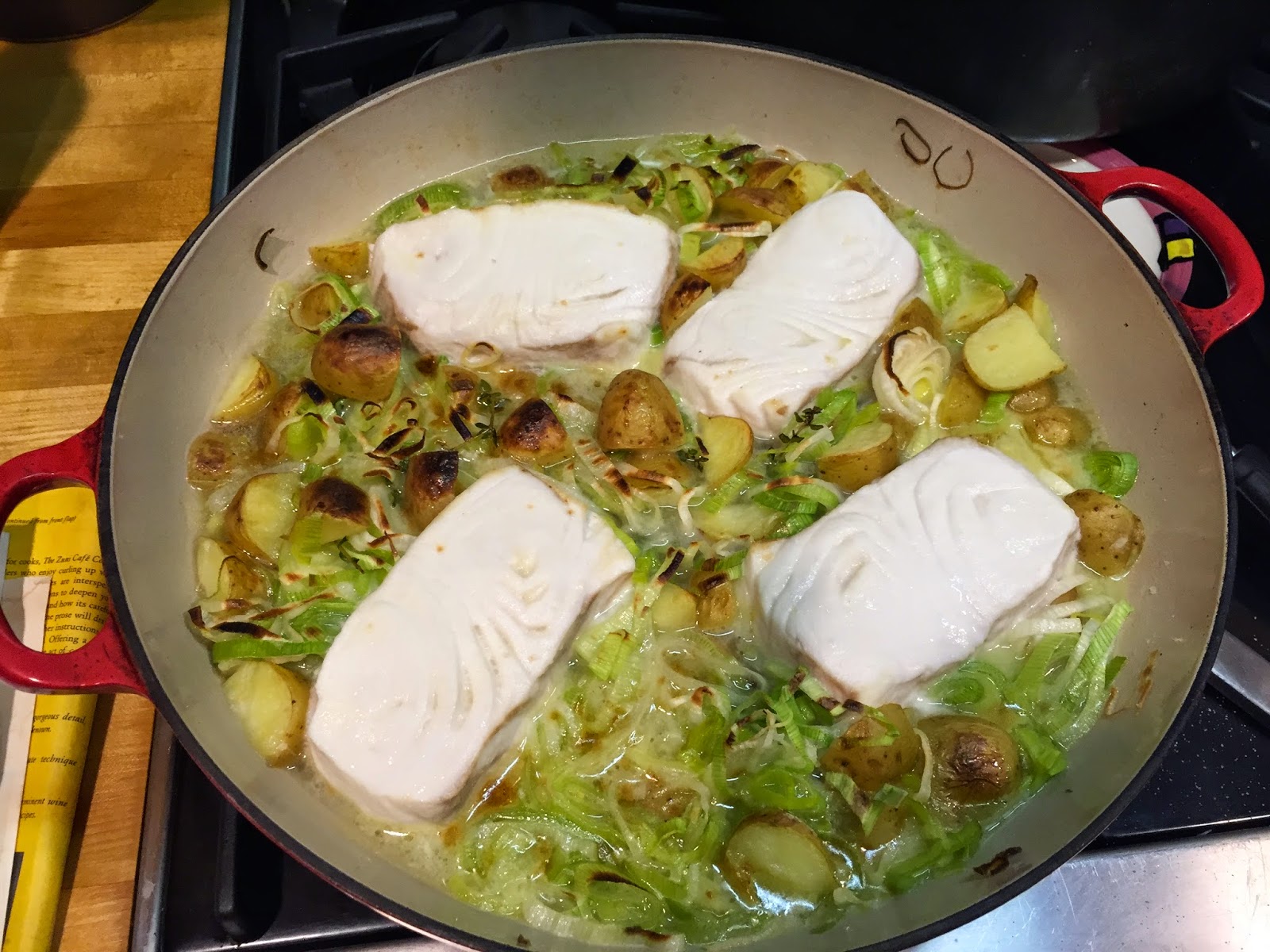
We decided to make a fish recipe from The Zuni Café Cookbook
by Judy Rodgers. We made Sea Bass with Leeks, Potatoes, & Thyme. It is definitely
a one dish meal. We purchased the fish at McCall’s Meat and Fish. This would
make a great dish on a cool night.
Sea Bass with Leeks, Potatoes, & Thyme
The Zuni Café Cookbook
Judy Rodgers
Sort of a bass bonne femme, the fish being cooked in a
chunky stew of leeks and potatoes that recalls that traditional French soup. We
use plump white sea bass fillets, but black bass and turbot are good
alternatives. The fillets need to be between 1 and 1-1/2 inches thick in order
to cook properly, which means avoiding tail pieces.
The first time you make this dish, plan to watch it closely
while it is in the very hot oven (all of about 10 minutes]. My pan placement
instructions and cooking times are necessarily only guidelines - you may need
to adjust one or both to the characteristics of your oven, pan, or fish.
for 4 servings:
4 pieces sea bass fillet, about 6 ounces each and 1 to 1-1/2
inches thick
Salt
About 3/4 pound peeled yellow-fleshed potatoes, preferably
yellow Finnish, Bintje, or German Butterballs, cut into irregular bite-sized
chunks
1-1/2 cups diced or thinly sliced leeks (including a little
bit of the green part)
A few sprigs of fresh thyme
About 1-1/4 cups Chicken Stock
A splash or so of dry white vermouth 6 tablespoons unsalted
butter, sliced and chilled
A trickle of Champagne vinegar or white wine vinegar, if
needed
Seasoning the fish (For the best flavor, do this a few hours
in advance}: Season the fish lightly and evenly with salt. Cover loosely and
refrigerate.
Cooking the fish:
Preheat the broiler. Position the rack so it is about 6
inches from the element.
Place the potatoes in a saucepan, add cold water to cover,
and set over medium heat. Season liberally with salt (we use a scant 1-1/2
teaspoons sea salt per quart}, stir, and taste. The water should taste as
seasoned as you would like the potatoes to be. Cook the potatoes at a gentle
simmer until quite tender and soft on the edges, about 5 minutes. (Some of the
soft potatoes will later diffuse in the sauce, giving the dish its homey
character.)
Drain the potatoes well and place them, still steaming, in a
12- or 14-inch ovenproof skillet. Add the leeks, thyme, about 1 cup of the
chicken stock, and a splash of vermouth. Set over medium heat and swirl as the
broth comes to a simmer. Add about 4 tablespoons of the butter, and swirl until
it melts. Taste for salt. Reduce the heat to low and add the fish. Swirl and
tilt the pan to baste the surface of the fish with the buttery broth. The
liquid level should rise as the bass releases moisture into the broth. If it
doesn't, add a little more chicken stock.
Make sure no bits of leek are stuck to the sides of the pan,
or marooned on top of the fish, and place the pan under the broiler. Cook until
the surface of the fish and potatoes is lightly gratineed, about 5 or 6
minutes. The liquid should be bubbling vigorously. Reduce the oven temperature
to 500. Cook until the fish is medium-rare, another 1 to 5 minutes.
While the fish is cooking, set a small, shallow platter and
four plates to warm in the oven for a minute or so, then remove.
Transfer the fish pan to the stovetop. Using a spatula and
tongs, lift the fish, tilt to drain slightly, then place on the warm platter,
protected from drafts (don't stack the pieces of fish). The fish will finish
cooking as it rests.
Swirl the pan gently over medium heat to encourage the
potatoes to thicken the sauce as it simmers. Taste. Add the remaining butter
and adjust the salt. Tilt the platter of fish over the pan and carefully drain
any liquid into the simmering sauce. Continue simmering to reduce the sauce as
needed, until it has a little body, then taste again. If it seems flat, add a
splash of vermouth or a few drops of vinegar. (Don't reach for lemon; its
perfume can easily dominate all others and, it is out of character for this
dish.) Transfer the fish to the warmed plates and spoon the sauce and potatoes
over all.
Note: At Zuni, this dish and the two fish dishes that follow
brown and reduce beautifully in our brick oven; the burner-then-hot-broiler
technique mimics those blistering conditions.
Saturday, May 02, 2015
Lobster Risotto
![]() |
| Beautiful Lobster Tails |
![]() |
| Tails Removed from Shell |
![]() |
| Butter Poaching the Lobster Tails |
![]() |
| Lobster Risotto Cakes |
This is about as good as it gets. Lobster Risotto! We
purchased the Tails and then I needed to remove the the tails from their shell.
I thought it would be difficult but it wasn’t. We then followed the recipe for Butter Poaching Lobster Tails. This takes the lobster meat and makes it
incredibly rich.
We then followed the New York Times recipe for Lobster
Risotto.
What can I say except it was fabulously decadent?
Butter-poached Lobster Tails Recipe
to Die For
I have always loved lobster but
rarely make it because I get the creeps by sticking a live lobster into a pot
of boiling water. It feels wrong and you really only end up eating the tail and
claws (I know, I know you can eat some other parts, too, but I’ll pass on
those). When I saw a deal on uncooked lobster tails though, I thought that was
more up my alley and why not treat myself once in a while.
I’ve had butter-poached lobster at
restaurants before, and loved it, yet have never made it myself. I took the
opportunity to grab the deal on uncooked lobster tails and try a new recipe all
in one. You can also add a side of cauliflower mashed
potatoes to this dish for an excellent
pairing. If you’re a lobster lover, this is an easy way to cook lobster and
it’s hard to overcook the meat. Oh yeah, and it’s supremely deliciously buttery
and tender and you’ll hear little angels singing in your ears.
Total Time:30 minutes
Number of Tails: 2, or however many you would like to cook, but this recipe is
for 2
Ingredients:
• 2 uncooked lobster tails
• 1 TB (Tablespoon) water
• ½ cup (1 stick) butter cut into 1
TB pieces
Cook it:
• Take kitchen scissors and cut the
shell of the lobster from the top of the back to the start of the tail then
flip it over and do the same thing on the other side
• Remove the meat from the shell
• In a medium saucepan, bring the
water to a simmer over medium-low heat
• Whisk in 1 piece (or 1 TB) butter
• When that piece has melted, add
another piece. Continue adding pieces of butter and whisking in this same
manner until you have added all the butter (do NOT let the butter come to a
boil or it will separate and you won’t have butter poached lobster tails)
• Add the shelled, uncooked lobster
tails to the butter and cook for 5-10 minutes turning them every so often
(Continue to make sure the mixture does not boil, if this means you need to
reduce the heat, that’s ok)
• Make sure the lobster is fully
cooked (i.e. not translucent anymore and is white and pink) then remove it from
the butter
Top the butter poached lobster with
the basil garnish and serve to your guests whose mouths are watering from the
tantalizing smell
Lobster Risotto
New York TImes
About 6 cups lobster stock
¼ cup butter
¼ cup extra-virgin olive oil
2 medium onions, finely chopped
Salt
2 cups arborio, carnaroli or other short-grained white rice
Meat from 1 cooked lobster, chopped
2 tablespoons minced chives
½ cup grated Parmesan
Freshly ground black pepper.
1.
In a medium pot, heat the stock and keep warm.
2.
In a large, wide saucepan, melt the butter in
the oil over medium-high heat. Add the onions and sauté until translucent,
about 4 minutes. Add a large pinch of salt, then add the rice and stir
constantly for about 2 minutes. Add 1 cup of broth and simmer, stirring until
the broth is almost absorbed. Add more broth, a cup at a time, allowing each
addition to be absorbed before adding the next. Stir often. Cook until the rice
is tender and the mixture is creamy, 20 to 25 minutes.
3.
Stir in the lobster meat until heated through,
then add the chives and ¼ cup of the Parmesan. Season to taste with salt and
pepper. Serve immediately with remaining Parmesan.
Wednesday, April 29, 2015
Ham and Lentils
It was another beautiful spring night in Silverlake. We had left over ham from the large piece we had purchased at McCall's Meat and Fish. We found this recipe for Ham Hocks with Red Lentil in the book Nature by Alain Ducasse. We weren't fond of this recipe, I doubt we will make it again. However, if the ingredients appeal to you, give it a shot. The wine was great.
Ham Hocks with Red Lentil
Nature
by Alain Ducasse
Serves
4
· Put 1 half-salted ham hock in a basin of water and leave to de-salt for
2 hours, several changes of water.
· Transfer to a flameproof casserole dish, not too large coyer with
water, and bring to a boil. Skim until the stock is clear, then add 1 bay leaf.
· In the meantime, peel and wash 3 carrots, 3 stalks of celery, and 4 spring
onions with stalks. Slice them
thinly, set aside, and add the trimmings (carrot and celery ends, the onion
stalks) to the casserole dish with the ham. Simmer gently, just below a boil,
for 2 hours.
· Then take out the vegetable trimmings. Rinse 1 cup of red lentils and
add to casserole dish.
· Cook for an additional 10 minutes or so, until the lentils are soft.
· In the meantime, in a saute pan with a drop of olive oil, sweat the
sliced vegetables with a pinch of salt for 4 minutes, with a lid on the pan.
· Chop the leaves of 3 sprigs of parsley and 1 sprig of tarragon.
· Take out the ham hock and keep it warm on a serving dish.
· Drain the lentils in a sieve over a bowl and add them to the saute pan
of vegetables.
· Add 3/4 cup of the cooking stock, 2 tablespoons of Dijon mustard, the
chopped herbs, and stir well.
· Add a twist of freshly ground black pepper and arrange the lentils
around the ham.
· Serve immediately.
Tuesday, April 28, 2015
Califlower and Ham Pasta
We were shopping at McCall's Meat and Fish and they were selling delicious looking hams. We decided to buy one to make a wonderful dish. Rigatoni Modo Mio (Pasta with Cauliflower and Ham) from Craig Claiborne’s The New York Times Cookbook. If you have never thought of a pasta made with cauliflower and ham this is the one for you! It is extremely satisfying. Summer like weather allowed us to eat outside on the back deck overlooking LA. You can get the recipe from our blog of: May 07, 2014. Click the date to get the recipe.
Friday, April 24, 2015
Halibut - Hold the Fear
The New York Times had an excellent article on cooking fish. It is worth a read. We went to McCall's Meat and Fish and bought Halibut. We cooked it as they suggested and served the fish with re-heated Potatoes and a simple Salad. It was an excellent dinner.
Conquering the Fear of Cooking Fish
New York Times
Recipe Lab: Pan-Roasted Fish Fillets
Julia Moskin pan-roasts fish with fresh herbs and butter.
By Andrew Scrivani and Jason Lee on Publish Date April 20,
2015.
Fear of fish can afflict even the most confident cook.
Fewer and fewer fish have crossed my stove in recent years.
This is partly out of guilt, because wild species are so often out of season or
endangered, and farmed fish are so often unappealing. It is partly because in
my apartment, to cook fish for dinner is to live with its smell for a day and a
half. And it is partly because I ate so much fancy fish in restaurants to make
up for my failings as a home cook that I had forgotten how delicious a simple
buttery pan-fried fillet can be.
The modern fashion in restaurants is to serve fillets
swimming in a broth, juice or nage (as if returning to water is somehow natural
for cooked fish). Other chefs like oil-poaching, which involves a slow simmer
in gallons of top-quality oil; expensive and impractical for Tuesday-night
dinner at home.
And others recommend that home cooks start with en
papillote: folding up individual fillets in parchment paper with butter and
herbs, which steams the fish and produces a kind of thin broth. This is not a
thrilling outcome.
For weeknight home cooking, I wanted a way to cook a fish
fillet the way I cook all my favorite proteins (steaks, shrimp, lamb chops):
quickly, simply and over high-enough heat to bring on the browning that makes
food crisp, appetizing and fragrant. (Food science nerds call them Maillard
reactions.) But a simple sear in oil isn’t the answer for fish: overcooked and
flavorless fillets are the result.
I brought the quandary to Mark Usewicz, a former chef
and current co-owner of Mermaid’s
Garden in Brooklyn, where he teaches classes for home cooks, like
“How to Cook Fish in a New York City Apartment.”
His solution (of course) involved butter.
The best way to cook a fish fillet, he said, is on top of
the stove in a heavy skillet, with constant attention — not a tall order, as
the whole process takes less than five minutes from start to finish. The short
cooking time seriously reduces the chance of lingering smells.
The initial sear should be in oil that will not burn over
high heat: grapeseed, canola or even extra-virgin olive oil. (Although experts
advise us not to waste extra-virgin oil on sautéing, using a few teaspoons here
and there is well worth it for convenience and taste.)
To finish the cooking, add a nut of butter to the pan, flip
the fillet and baste furiously. The melting butter will keep the flesh tender,
help form a tasty crust and finally brown lightly to become a sauce for the
finished dish. A few fresh herb sprigs tossed in at the same time perfume the
whole thing nicely.
“It’s a variation on the most basic restaurant recipe, the
first one you learn at the fish station,” he said. In most restaurant kitchens,
the cooking starts on top of the stove but is finished in a hot oven, to make
room for the next table’s order. For home cooks, heating the oven to 400
degrees for five minutes of cooking time is an unnecessary step.
Renee Erickson, a Seattle
chef who specializes in seafood at her restaurants, the Whale Wins, the Walrus
and the Carpenter, Boat Street Café and Barnacle, also relies on butter-basting
as the best basic way to cook fillets, from fatty salmon to slender flounder.
“There are more delicate ways to cook fish, I suppose,” she said, but not
tastier ones.
“If you order a pan-fried fillet from one of our kitchens,
it comes out seriously browned,” she said. If the pan and contents get too hot
during the cooking and threaten to scorch, she advised, add a bit more cold
butter or squeeze in the juice of half a lemon.
The method works for small whole fish, too, she said, as
well as skinless and skin-on fillets. You can score the skin with the tip of a
sharp knife to prevent the fillet from curling as it cooks or (even easier)
just press down on it lightly for the first minute or so of cooking.
What kind of fish to buy for this dish? Assuming your fish
is in good shape, and the right thickness — not less than a half-inch thick or
more than an inch — almost any fillet can be cooked this way, from brook trout
to Arctic char. Black cod, rockfish and halibut are excellent choices from the
Pacific; from the Atlantic, sea bass, grouper and snappers; red drum from the
Gulf of Mexico.
Mr. Usewicz said that selecting the right fish for a
particular recipe is prominent among the anxieties people bring into his shop.
“It is amazing how afraid people are of fish,” he said.
“Afraid of cooking it, afraid of buying it, afraid of keeping it.” Most of his
customers, for example, firmly believe that fish can’t even be kept overnight
in the refrigerator without spoiling. “Fish is like any other kind of protein,”
he said. “It’s perishable.” But that doesn’t mean it’s on the verge of
spoilage.
“A really nice piece of fish lasts a few days in the fridge,
and it doesn’t smell up your house any more than steak does,” he said, as long
as it’s been treated properly from the moment of catch. That usually means
eviscerated on deck, frozen or flown to market within hours and kept cold at
all points on the way to the case.
“People get all caught up in choosing exactly the right kind
of fish,” he said. “But really, the most important thing that will affect your
dish is how it’s handled before you ever see it.”
Thursday, April 23, 2015
Salmon Cakes
![]() |
| Cakes ready to be fried |
![]() |
| Getting Crispy |
![]() |
| Wolfgang Puck Lyonaise Potatoes |
![]() |
| Perfection! |
We hit the jackpot with our Salmon Patties. One more use
of our left-over Smoked Salmon. You can find the recipe for the Salmon and Dill Fish Cakes
from The Kitchen Diaries by Nigel Slater on our
blog of: June 4, 2012. Click the date to get the
recipe. We served the patties over a Salad topped with Lyonnaise Potatoes from Wolfgang Puck's Modern FrenchCooking for the American Kitchen. The recipe can be found on our blog of: June
23, 2012. Click the date to get the recipe.
Tuesday, April 21, 2015
Scrambled Eggs Donburi
One of the best parts of making a large Smoked Salmon is
using the leftover salmon in other dishes.
What is better than a Salmon Bowl? We used a recipe for Nobu's Scrambled
Eggs Donburi. We always have liked Donburi and Nobu’s restaurant Matsuhisa,
is one of our favorites. You can find the recipe for this delicious dish on our
blog of: April
29, 2014. Click the date to get the recipe. It is EASY and worth it. Doesn’t
it look delicious? It is!
Subscribe to:
Posts (Atom)