Sunday, July 04, 2010

July 4th

Every July 4th we have a party and watch fireworks from from our deck. This year was no exception. It is always touch and go as to the weather. Sometimes it can be foggy and you can’t really see much. This year it was clear and we watched the fireworks, both legal and illegal, from Silverlake to the Ocean.

Everyone contributed to the meal. We started on the deck with Cheeses and Rivera Cup Cocktails. Fran and Tom brought Guacamole and Chips and a great Hot Crab Spread. They also introduced us to a new olive: Graber's that I had never tried before. They were very meaty.

I grilled steaks from McCall’s Meat and Fish. Once again we used the Babo recipe for Dry Rubbed Rib-Eye Steak from the Babbo Cookbook by Mario Batali. It is the best rub! You can get the recipe from our blog of April 10, 2010: Just click the date to get the recipe. Nate at McCall's couldn’t believe how many steaks we bought for 8 people (4 very large ones) and promised us there would be leftovers. Unfortunately there wasn’t. At least we saved the bones for Daryl and Robert’s dogs!

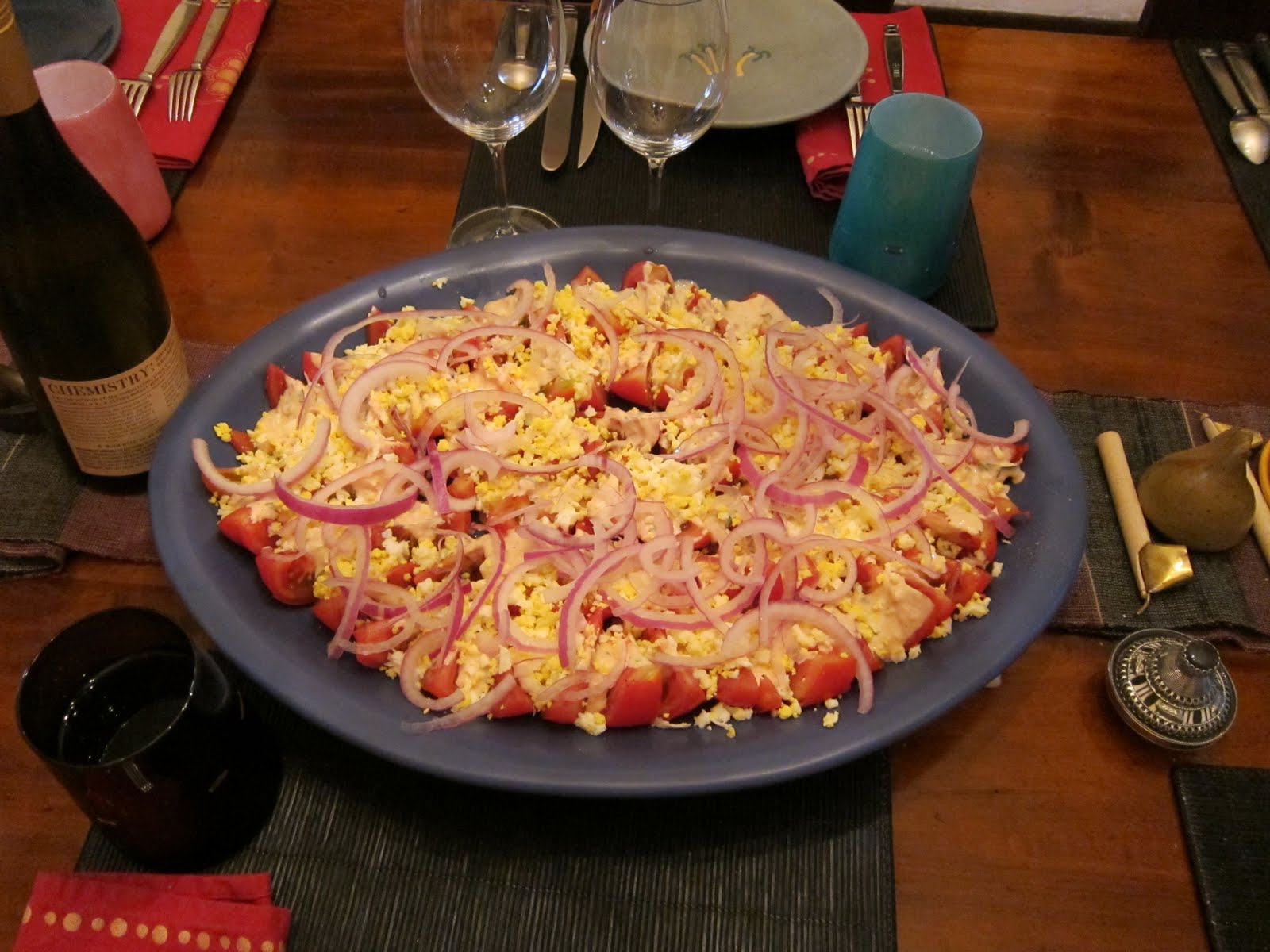
We started with one of my favorite tomato salad recipes from Campanile: Green and Red Tomato Salad with Russian Dressing from New Classic Family Dinners by Mark Peel.  The Russian Dressing is exceptional. We did cheat however and use Best Foods mayo rather than make our own. We crushed garlic into it. This is a fabulous salad when tomatoes are at their peak.

Billy / Kevin brought a Potato Gratin. It was yummy crispy with lots of onions. I don’t know the recipe, but on the other hand, if I can always convince Billy to make it, I don’t need to know the recipe!

For dessert Daryl and Robert brought not one but two tarts that they made: a delicious Sour Cherry Pie and a Tarte Tatin.

We finished with Ginja Cherry Liquor. We had it in Lisbon (it is their national drink) and finally found it here in the US.

It sure makes the dinner easier when everyone contributes a dish (especially if they are ALL good cooks!).

green and red tomato salad with russian dressing
[makes 4 to 6 servings]
New Classic Family Dinners
Mark Peel

I made this dish after seeing the movie Fried Green Tomatoes. It's a perfect salad to make at the end of summer or the middle of fall (depending on where you live), that time of year when the last of the tomatoes have come in and the green ones that are still growing on your vines will never fully ripen. Tomatoes with Russian dressing is one of my favorite steak house combos. This rendition with green and red tomatoes is a great study in contrasts—creamy and chunky (dressing and tomatoes), sweet (red),and sharp (green), crisp (green) and juicy (red). I use beefsteak tomatoes for this; they're perfect for any all-tomato salad. They slice well and have a great firm texture.

[RUSSIAN DRESSING]

1     large egg, hard-boiled (below)
½    recipe Garlic Mayonnaise (below)
½    teaspoon white wine vinegar or champagne vinegar
1     teaspoon freshly squeezed lemon juice
3     tablespoons Heinz ketchup
¼    teaspoon Lee & Perrins Worcestershire sauce
¼    teaspoon Tabasco sauce (more to taste)
2    tablespoons finely chopped red onion, soaked in cold water for 5 minutes, drained, rinsed, and dried on paper towels
1    teaspoons (packed) grated fresh or prepared horseradish
1    tablespoon finely chopped fresh flat-leaf parsley
Salt
1/8  teaspoon ground black pepper
[SALAD]

I ¾     pounds mixed green and red tomatoes, sliced 1/4 inch thick Kosher salt and freshly ground black pepper to taste
1    hard-boiled egg, finely chopped
1    teaspoon finely chopped fresh flat-leaf parsley
½    red onion, sliced very thin in half-moons, soaked in cold water for 5 minutes, drained, rinsed, and dried on paper towels

[HARD-BOILED EGGS]

Place the eggs in a medium saucepan, cover with cold water, and bring to a boil. Cover the pot tightly and turn off the heat. Meanwhile, fill a bowl with ice and water Let sit for 10 minutes for a dark, very slightly soft yolk, 12 minutes for a lighter; thoroughly hard-boiled but still very tender yolk. Drain and chill in the ice bath for several minutes, then peel.

1.             Make the Russian Dressing: Peel the hard-boiled eggs, cut in half (or break the eggs in half and scoop out the yolks and whites), and remove the yolks from the whites. Chop the whites very fine. Separately, chop the yolks very fine and mix with a tablespoon of the mayonnaise. They should almost be a puree (and indeed, you can puree them through a sieve instead of chopping them). Set aside.

2.             Place the rest of the garlic mayonnaise in a bowl. Stir in the vinegar, lemon juice, ketchup, Worcestershire,Tabasco, onion, horseradish, and parsley. Season to taste with about 1/4 teaspoon salt and the pepper Stir in the minced hard-cooked egg whites and the yolks. Taste and adjust the seasonings. Transfer to a covered container and refrigerate. It will keep for about 5 days in the refrigerator

3.             Make the salad: Line an oval or round platter with the tomato slices, overlapping them slightly and alternating red and green. Season with salt and pepper and let sit for 10 minutes.

4.             Spoon the dressing over the tomatoes. Sprinkle on the chopped egg and the parsley and if you wish, top with the onion slices. Serve.

VARIATION /THOUSAND ISLAND DRESSING
Substitute 1/4 cup finely chopped cornichons for the horseradish.

[GARLIC MAYONNAISE, makes  1 1/4 cups]
This isn't as garlicky as Provencal aoli but it's garlicky nonetheless. The bread, blended as it is with the egg yolk, makes for a tighter mayo.

1/4   cup diced baguette, without crusts
2   teaspoons white wine vinegar
1       to 2 fat garlic cloves (to taste), halved, green shoot removed, quartered
1/2   teaspoon kosher salt (more to taste)
1/2   cup plus 1 teaspoon canola oil, at room temperature
1       large egg yolk
1   tablespoon warm water
1       level teaspoon Dijon mustard
1/2   cup extra virgin olive oil, at room temperature
1       teaspoon freshly squeezed lemon juice

1.    Place the diced bread in a small bowl and toss with the vinegar until saturated. Squeeze the bread over the bowl, extracting as much vinegar as you can (you may not be able to squeeze out any at all), and set the bread aside.

2.    Place the garlic, salt, and I teaspoon of canola oil in a mortar and mash to a paste; don't pound the garlic, but grind it against the sides and bottom of the bowl. Add the bread and continue to mash until the mixture is smooth. Add the egg yolk, water; 1 teaspoon of the vinegar squeezed from the bread, and the mustard and mix together thoroughly. Slowly begin to drizzle in the remaining canola oil, stirring constantly with the pestle. When you've added about a third of the canola oil and the mixture has begun
3.    to emulsify, scrape the mixture into a medium bowl. Wet a dish towel and wrap it around the base of the bowl so the bowl doesn't move around while you whisk. Switch to a wire whisk.

4.    Very slowly drizzle in the remaining canola oil while whisking constantly. When all of the canola oil has been added, drizzle in the olive oil, whisking all the while. Once the mixture has emulsified you can add the oil a little more quickly. Add the remaining vinegar and the lemon juice. Taste and adjust the seasoning, adding more vinegar or lemon juice ,or salt if desired. Scrape into a jar or small bowl, cover tightly, and refrigerate until ready to use.

[MASHING GARLIC AND OTHER INGREDIENTS IN A MORTAR AND PESTLE]

When a recipe instructs you to mash garlic to a paste, it means to mash by grinding, not by pounding.The movement of the pestle should not be up and down but circular If you pound the garlic, you'll release too many volatile oils and your puree will be too pungent. Also, you risk breaking your mortar It's just as easy to get a smooth puree by slowly but firmly grinding the garlic against the sides and bottom of the mortar

HEINZ KETCHUP, LEE & PERRIN’s
WORCESTERSHIRE SAUCE, AND TABASCO
Some commercial brands of food have their place in gastronomy, and the above-named are three of them. You can rely on their quality and consistency when you use them to season dishes.This point was brought home to me when I was a young chef, training at the 3-star French chef Roger Verge's restaurant Moulin de Mougins in the south of France. One afternoon between the lunch and dinner service, Chef Verge came into the kitchen to prepare a late lunch of steak tartare for his friends. He grabbed a superb piece of sirloin and I watched as he hand-chopped it with impressive skill. He seasoned the meat, then reached into a cabinet and pulled out some Heinz Ketchup to mix into the tartare. I couldn't believe my eyes, but it was at that moment I realized that a good product is a good product, worthy of even a 3-star kitchen.


Wednesday, June 30, 2010

Shu Mai Burgers!


The New York Times had a recipe for Shu Mai Burgers! The idea was a crazy take on the familiar Shu Mai that are always the ultimate test of Din Sum (unless your ultimate test is chicken feet). We purchased the Pork Shoulder and the Shrimp and from McCall’s Meat and Fish. The results were amazing! The Shu Mai Burgers tasted and had the slightly chewy texture of Din Sum. They were simply bigger and flatter!

The recipe didn’t indicate two things that we figured out. First we were unclear if you use raw shrimp or cooked shrimp. We went with the fresh shrimps from McCalls. We simply cleaned them and thru them through the meat grinder, interspersing with the chunks of pork shoulder. The other thing was the meat was so fatty (yea, that is where the flavor is) we pan fried the Shu Mai without oil. This is a dish we will definitely make again! We served them without a bun on the plate with Yakisoba With Pork and Cabbage. This is another recipe from the New York Times. You can find it in our blog of: March 7, 2010. Simple click the date to get the recipe. Cathy had the good sense to leave the pork out of the recipe, since we were having so much pork in the Shu Mai.
We had purchased Fresh Cherries at the Farmer’s Market. We served them with outrageously rich Maraschino Cherries. 


Shu Mai-Style Burgers


New York Times


Time: 30 minutes


1/2 pound shrimp, peeled


2 medium cloves garlic


1 1/2 pounds boneless pork shoulder, with the fat, cut into 1-inch cubes


2 teaspoons soy sauce


1/4 cup chopped scallion plus more for garnish


1/4 cup chopped cilantro plus more for garnish


1 small fresh chili, seeded and minced


1 tablespoon minced fresh ginger


Salt and freshly ground black pepper to taste


Shredded cabbage and pickled pepper, to garnish (optional).


1. If grilling or broiling, heat should be medium-high and rack about 4 inches from fire. Put shrimp and garlic in a food processor and pulse until just chopped; remove to a large bowl. Working in batches, grind pork fat until just chopped (be careful not to over-process). Add to bowl. Then grind meat until just chopped, again being careful not to over-process; add to bowl.


2. Mix shrimp, pork fat and meat with the soy sauce, scallion, cilantro, chili and ginger; sprinkle with salt and pepper. Shape into 8 patties.


3. To broil or grill, cook about 4 minutes, then turn and cook for a total of 8 to 10 minutes, or until nicely browned and cooked through. For stovetop, heat a large skillet over medium heat for 2 or 3 minutes, then add the patties; cook undisturbed, for about 4 minutes, then turn and cook for a total of 8 to 10 minutes, or until nicely browned and cooked through.


4. Garnish with scallion, cilantro, cabbage and pickled pepper, to taste.


Yield: 8 burgers.

Monday, June 28, 2010

Asparagus and Mushroom Risotto


We went to the Hollywood Farmer’s Market and they had some last of the season Morel Mushrooms and delicious fresh figs. We started with a Salad made from Prosciutto, Figs, Hazelnuts, and Ricotta Salata Cheese.

For the main course we had a Mushroom Asparagus Risotto. We used the recipe for Risotto con Luganegh Risotto with Pork Sausage, from The Cuisine of Venice & Surrounding Northern Regions by Guisti-Lanham Dodi. We left the sausage out because the mushrooms were so wonderful. At the very end we put cut up asparagus into the mushroom. It was a great enhancement! You can find the recipe for the risotto in our blog of: April 11, 2009. Click the date to get the recipe.

Tuesday, June 22, 2010

Vegetarian Moroccan


We made another asparagus appetizer. Asparagus with Burrata Cheese from The Cheese Store of Silverlake, Hazelnuts from Mozza-2go and Browned Butter. The title is the recipe!
It is a delicious way to eat asparagus!

For the main course we made a Vegetarian Moroccan Dish which translates to Baked Vegetables with Prunes. It is from the cookbook: The Food of Morocco It has chili in it, and it gives it a real kick.

We served it over couscous. Interestingly (at least to us) I thought tagines were always served over couscous. In Morocco they aren’t. It is two different dinners. A couscous has something over it. A tagine is a method of cooking in a ceramic pot, that may or may not be served over couscous. This is a good (and relatively easy dish) to make. It might be a little tricky to find the mixture of spices called ras el hanout, but it is worth it. I know that The Spice Station in Silverlake sells it. They Ship!

KHODRA BEL BARKOOK
Baked Vegetables With Prunes
While this would normally be cooked in a tagine over a charcoal fire, when baked, the vegetables and onions caramelise for extra flavour, further enhanced with ras el hanout the prunes add a pleasant sweet-sour flavor to this dish.

1/4 cup olive oil ■
2 red onions, peeled and quartered
3 garlic cloves, bruised unpeeled 2 sliced carrots
1 lb pumpkin (winter squash)
1 lb orange sweet potato
11/2 teaspoons ras el hanout
1 red chilli, seeded and sliced
11/2Cups light chicken or vegetable stock scant 1 cup prunes
1 tablespoon honey
SERVES 4

POUR the olive oil into a 12 x 16 x 21/2 in ovenproof dish and add the onions, garlic and carrots. Toss well. Bake in a preheated 400° oven for 15 minutes.
PEEL and cut the pumpkin and orange sweet potato into large chunks. Add to the dish, along with the ras el hanout and red chilli. Season and toss well.
BAKE for a further 30 minutes. Stir in the light chicken or vegetable stock, prunes and honey and return to the oven for a further 30 minutes. Serve with steamed couscous or as a vegetable accompaniment.

Thursday, June 17, 2010

Morel Mushrooms, Figs!


We made Asparagus with Morel Mushrooms. It is an extremely rich dish. What a combination. It is another one of our summer favorites. We follow the recipe for Sauted Fresh Morels from Chez Panisse Vegetables by Alice Waters. Simply make and serve over the cooked asparagus.

For the main course we made Chicken With Figs. This is one of our favorite summer chicken dishes, we only make it when there are fresh figs at the market. The recipe is from The Zuni Café Cookbook. It is easy and very tasty. The dish is called. Chicken Braised with Figs, Honey & Vinegar. The name tells the story. You can get the recipe from out blog entry of June 23, 2008. To get the recipe click the link.


Sauted Fresh Morels
Chez Panisse Vegetables
Alice Waters


5 ounces morels
2 large shallots
1 small clove garlic
1 tablespoon olive oil
2 tablespoons unsalted butter
Salt and pepper
Lemon juice
2 tablespoons chopped parsley

Clean the mushrooms with a brush or paring knife, removing any dirt or debris. If they appear to be sandy, wash briefly in water and drain. Depending on their size, halve or quarter the morels.

Peel and finely chop the shallots and garlic. Heat the olive oil and half the butter in a saute pan. Add the shallots and garlic and cook over low heat for 2 or 3 minutes.s, until the shallots look translucent. Add the morels and about ½ cup water, and season lightly with salt and pepper. Cover and simmer about 4 minutes. Uncover, add the remaining butter, raise the heat slightly, and cook about 3 minutes more, until the morels are soft and tender and the liquid has almost completely evaporated.

Turn off the heat, squeeze a few drops of lemon juice over the mush­rooms, adjust the seasoning, and toss in the chopped parsley. Serve im­mediately.


Pasta June 9, 2010

Wednesday, June 16, 2010

First Dinner Back


We returned to the states from our trip and we were very jet-lagged. We decided to make some simple dinners.

We went to the Santa Monica Farmer’s Market and David West, the mushroom man, had lots of Porcini’s and also Morels. We started with a salad of White Nectarines, Prosciutto, and Almonds then dressed with Saba. We really like salads with fresh fruit in the summer.

For the main course we made Tagliatelle with Fresh Porcini Mushrooms. It is a favorite! It is very easy to make and delicious. You can get the recipe from our blog of: June 9, 2009. Click the date to get the recipe.

Tuesday, May 04, 2010

1st Egg of the Season


With the advent of decent weather we decided to use our Egg for the first time in a long time. The weather had been too cold to grill outside.

Once again we grilled a Herb-Crusted Pork Loin on the egg using the recipe from License to Grill by Chris Schlesinger, It was perfect! We really enjoyed it. The recipe can be found in our blog entry of: July 2, 2008. Click the date to get the recipe. Of course we got the meat at McCall’s Meat and Fish.

This is such a perfect dish for the egg. I use alder wood to smoke the meat and the marinade of all the herbs made the pork especially fragrant. We will have lots of leftovers from the meal.

We started with fresh asparagus that we topped with Buratta Cheese and amazing hazelnuts that we purchased at Mozza2Go.

In fact, Cathy took the leftover polenta and layered it in a casserole with Candied tomatoes that we had made last year and frozen. We topped the polenta with Buratta Cheese then topped with Parmesan Cheese. Talk about rich!

Monday, April 26, 2010

New Recipe, Old Recipe


Asparagus is at its best at the Hollywood Farmer’s Market right now. There was a new recipe in the New York Times for: Baked Asparagus With Shiitake, Prosciutto and Couscous and we decided to make it.

We had picked up some fresh Asparagus and also found a very unusual mushroom called “King Trumpet Mushroom”. It looked like a giant Porcini mushroothm. The recipe calls for the asparagus to be roasted inside parchment. It is a wonderful recipe. We really like the taste of the saltiness of the prosciutto combined with mushroom essence captured by the enclosure.
English Pea season is almost over. We make for probably the last time this year: Orecchiette Carbonara with English Peas and Pea Shoots from a recipe by Suzanne Goin in the fabulous cookbook: Sunday Suppers at Lucques. You can get the recipe from our blog of: April 29, 2009. Click the date to get the recipe. We didn’t even have to shell the peas. We simply washed them and cut them up, shell and all. Of course we used Nueske’s Bacon, our favorite!

Baked Asparagus With Shiitake, Prosciutto and Couscous
New York Times
1 pound asparagus, ends trimmed
1/4 pound shiitake mushrooms, stems removed, sliced 1/4-inch thick
2 ounces thinly sliced prosciutto, cut into 1/4-inch strips
2 tablespoons extra virgin olive oil, plus 2 teaspoons; additional for drizzling
1/2 teaspoon kosher salt
Ground black pepper, to taste
Grated nutmeg
3 tarragon sprigs
3/4 cup whole-wheat couscous
1. Heat oven to 200 degrees. Line a baking sheet with parchment paper (it should be twice as long as pan). Lay asparagus in a pile in center. Scatter mushrooms and prosciutto on top. Drizzle with 2 tablespoons oil and season with 1/4 teaspoon salt, the pepper and nutmeg. Toss vegetables to coat evenly. Lay tarragon over top.
2. Fold parchment to completely enclose vegetables, and staple top and sides shut (or tie up with string). Transfer pan to oven and bake for one hour. Asparagus should be just cooked through. If too crisp, return to oven until done to taste.
3. In a small pot over medium-high heat, bring 3/4 cup plus 3 tablespoons water, 2 teaspoons olive oil and remaining salt to a simmer. Stir in couscous and remove pot from heat. Cover and let stand for 5 minutes. Fluff with fork.
4. Spoon couscous onto serving plates and drizzle with oil. Divide prosciutto and vegetables, and their juices, among the plates and serve.
Yield: 2 main-course servings, or 4 side-dish servings.

Tuesday, April 20, 2010

Chinese Japanese Combo Plate


Los Angeles has an abundance of great Chinese Restaurants and we love go out to Monterey Park and other East LA locations to try the various regional Chinese cuisines. We decided to cook Chinese at home and found two great recipes (one was Japanese).

Barbara Tropp was a friend and had a great Chinese restaurant in San Francisco. We remember her and the restaurant China Moon fondly. On opening night when we were there Danny Kaye (who besides being an actor loved to cook Chinese food) came in by himself at sat alone at the counter to eat her food. We have always loved fried rice and thought the best fried rice we had ever eaten was in Hong Kong.

We decided to make Barbara’s recipe for Shrimp, Leek, and Pine Nut Fried Ricee from The Modern Art of Chinese Cooking. It was WONDERFUL! This recipe is a keeper. It reads more complicated then the recipe actually is. If you like shrimp (sorry Bea) you will like this one!

The New York Times had a recipe for Yakisoba that Mark Bittman their food editor created. We made a variation on it that we found on the web. It went perfectly with the Fried Rice.


Shrimp, Leek, and Pine Nut Fried Rice
From: The Modern Art of Chinese Cooking
By Barbara Tropp


This is a dish of my own devising, one which combines the northern Chinese taste for leeks, the eastern penchant for pine nuts, and the southern Chinese liking for shrimp with fried rice. It would prove baffling to a food historian, but I think it delicious. Unlike the more homey fried rice recipes above, this is a rather grand bowl following to the relative of the ingredients and the care required to prepare them. Use only short-or medium-grain rice; its plump shape and creamy texture mate perfectly with the shrimp and the pine nuts. If possible, marinate the shrimp 12-24 hours to give them time to absorb the seasonings. With preparations done, stir-frying the rice takes only 10-15 minutes.

TECHNIQUE NOTES:
Deep-frying marinated shrimp in warm oil prior to stir-frying "cooks" the exterior, protects the delicate flesh from the high heat of stir-frying, and eliminates any problem of the shrimp sticking to the pan. It is an extra step well worth the results. The shrimp becomes so velvety and succulent that people mistake it for lobster.

Serves 2-3 as a one-bowl meal, 4-5 as a large bowlful, or 6-8 as a small portion in a multicourse meal.

INGREDIENTS:

3 1/2 cups cold cooked rice, short- or medium-grain best
3 large eggs
1/2 pound small or medium-size fresh shrimp

To marinate the shrimp:
1 tablespoon egg white
2 teaspoons Chinese rice wine or quality, dry sherry
1/2 teaspoon coarse kosher salt 1
1 tablespoon cornstarch
1/2 pound tender, young leeks (to yield 2/3 cup thinly sliced leeks)
1/2 cup pine nuts
3-4 cups fresh corn or peanut oil, for velveting the shrimp

To stir-fry the leeks:
1/8 teaspoon coarse kosher salt
1/8 teaspoon sugar
1 1/2 teaspoons Chinese rice wine or quality, dry sherry
about 1 teaspoon coarse kosher salt

Preparations:
Cook the rice. Fluff, let stand until cool, then seal airtight and refrigerate overnight. Or, for use within the hour, spread the rice on a baking sheet and refrigerate, uncovered, until cool.
Separate one of the eggs and measure out 1 tablespoon egg white for the shrimp. Lightly beat the yolk and remaining white together with 2 whole eggs, then seal airtight and refrigerate until use, overnight if desired.

Shell and devein the shrimp, rinse, then pat dry. Combine the reserved egg white, wine, salt, and cornstarch in a small bowl, whisking until smooth and slightly thick. Add the shrimp, toss well with your fingers to coat, then seal airtight and refrigerate at least 3-6 hours so the shrimp absorb the marinade. For best results, refrigerate a full 24 hours. Bring to room temperature before cooking.

Trim the leeks of their stems and green tops, leaving only 1 inch of the more tender, light green neck. Cut in half lengthwise, and discard the outer layer of leek if it is, as typically, tough, wilted, or discolored. Slice the leeks crosswise into thin half-moons, a scant 'A inch thick. Rinse thoroughly in a large bowl of cold water, stirring to dislodge dirt, then drain and rinse again. Shake off excess water and put aside until use, sealed airtight and refrigerated, overnight if you like. Toasting the pine nuts and velveting the shrimp.

An hour to 30 minutes before stir-frying the rice, spread the pine nuts c% a heavy jelly-roll pan or doubled baking sheets (to prevent browning the bottoms of the nuts), and toast in a preheated 300° oven until fragrant and only lightly speckled with brown, about 4-5 minutes. Transfer the nuts to a shallow dish.

About 15-20 minutes in advance of stir-frying, assemble all the ingredients within easy reach of your stovetop. Have an extra bowl and a large Chinese mesh spoon or metal sieve that will nest directly on top of the bowl nearby. Put a large serving bowl or individual rice bowls in a low oven to warm.

Heat a wok or deep, heavy skillet over high heat until hot enough to evaporate a bead of water on contact. Add the oil for velveting, then heat to the slow-fry stage, 275° on a deep-fry thermometer, reducing the heat to medium or low once it has reached 200° to prevent it from climbing too quickly. When the oil reaches 275°, turn off the heat and slide the shrimp into the oil. They will sink to the bottom and bubble gently. Nudge the shrimp gently with chopsticks to keep them afloat and separate until they turn 90 percent pinkish-white, about 15-20 seconds, then scoop them immediately from the oil in one movement with the mesh spoon or sieve. Hold the shrimp briefly above the oil to drain, then put the spoon or sieve atop the waiting bowl to let them drain further. They will look mottled, and the inside will be raw.

Proceed immediately to stir-fry the rice. If you must use the deep-frying pot, then very carefully drain the oil into a heatproof bowl or pot. Use the hot oil for stir-frying. When the remainder cools, it may be strained and bottled for future use.

Stir-frying the dish:
Have an extra bowl nearby to hold the eggs and beat them lightly to recombine.

Heat a wok or a medium-size, heavy skillet or omelet pan over high heat until hot enough to evaporate a bead of water on contact. Add 2Vi tablespoons oil, swirl to coat the pan, then reduce the heat to moderate. When the oil is hot enough to puff a drop of egg on contact, add the eggs. Allow several seconds for them to puff and swell and the bottom to set, then gently push the cooked egg to the far side of the pan, tilting the pan
toward you if needed so the uncooked, liquid portion flows beneath and comes in contact with the pan. Repeat the process until there is no liquid egg left to flow, then imme¬diately scrape the egg into the bowl and break it into bits. It should be soft, slightly runny, and golden. (If you cooked it to 100 percent doneness, then you cooked it too long. If it has browned, then the heat was too high.)

Wipe the wok clean of any egg bits, then return it or a large, heavy skillet to high heat until hot enough to evaporate a bead of water on contact. Add 2 1/2 tablespoons oil, swirl to coat the pan, then reduce the heat to medium-high. When the oil is hot enough to sizzle one piece of leek, add the leeks stir-fry-briskly to coat them with the oil, adjusting the heat so they sizzle merrily without scorching. When evenly glazed, sprinkle with 1/8 teaspoon salt and sugar, then toss until they turn soft, about 30 seconds. Add the shrimp, stir several times to mix, then sprinkle in the wine. Pause a split second to allow the alcohol to "explode" in a fragrant hiss, toss to blend, then add the rice to the pan. Toss briskly to combine and heat the rice through, about 2 minutes, lowering the heat if the rice starts to scorch and pushing the rice to one side and dribbling in a bit more oil from the side of the pan if necessary to prevent sticking. Once I»t, reduce the heat to low and season the rice carefully •with-salt, keeping it on the light side to show off the richness of the pine nuts. When the taste is right, return the eggs to the pan and toss gently to combine, then sprinkle in the pine nuts and toss 5-10 seconds to mix, until the mixture is heated through.

For best flavor, serve immediately. If the rice must be held, cover it tightly and
place it in a steamer set over low heat or in a low oven. If it was cooked in a heavy pot, the pot may be taken off the heat and covered tightly and the rice will stay warm for about 20 minutes.

Leftovers will keep 3-4 days, refrigerated and sealed airtight. Reheat, covered tightly, in a steamer set over high heat or in a hot oven.

Bittman’s Yakisoba
(Adapted from The Minimalist)
Ingredients
6 ounces dried Chinese egg noodles, or 10 to 12 ounces fresh
1 tbsp sesame oil
3 tbsp peanut oil
3 tbsp minced ginger
1 box firm tofu, sliced
1 small head Napa cabbage, shredded (about 4-5 cups)
2-3 carrots, shredded
2 tbsp ketchup
¼ cup soy sauce
¼ cup Worcestershire sauce
2 tbsp mirin, or a bit of sugar
1-2 tbsp Sriracha, or to taste
1 bunch scallions, chopped, white and green parts
Method
. Remove the tofu from its packaging and wrap in an absorbent towel. Place a heavy cookbook or pot on top to drain it of excess liquid. After several minutes, remove from towel and cut into 3/4 inch cubes or slices.
. Bring a pot of water to a boil, salt it and add noodles. Cook until just done, about 3 minutes. Drain in a colander and run under cold water. Toss noodles with sesame oil to keep them from sticking together, and set aside.
. Put peanut oil in a large skillet over medium-high heat. When it’s hot, add ginger and cook, stirring, until just fragrant, about 1 minute. Add half of the tofu and cook for a few minutes until the tofu is starting to brown around the edges.
. Add cabbage and carrots to skillet and stir; sprinkle with salt. Continue to cook until vegetables soften, adding a bit of water as needed to keep them from sticking.
Meanwhile, stir together in a small bowl ketchup, soy sauce, Worcestershire sauce, mirin (or sugar), and Sriracha. When vegetables are soft and any liquid has evaporated, add noodles, remaining tofu, and sauce to skillet. Toss to coat everything well and cook until noodles are warmed through. Serve, topped with chopped scallions.

Monday, April 19, 2010

Moroccan Chicken and Turkish Leeks


Once again we decided to make Expatriate Roast Chicken with Lemon and Olives from The Slow Mediterranean Kitchen by Paula Wolfert. It is absolutely one of our favorite chicken dishes. It is very moist and I love the taste of preserved lemons and olives. You can find the recipe in our blog of Aug 2, 2008. Click the date to get the recipe.

Cathy found a new recipe (to us) in the same cookbook. It is for Leeks Simmered in Olive Oil. It was declicious and had the advantage of being able to be cooked ahead of time and served at room temperature. It has a fabulous texture due to the rice that is added to the leeks. It gives the dish a great crunch. We will definitely make this again.


Leeks Simmered in Olive Oil
From The Slow Mediterranean Kitchen
By Paula Wolfert

The slower, the better, when you simmer the leeks," my Turkish friend and fellow foodie Engin Akin advises me on the phone from Istanbul. Engin, who hosts a weekly food show on Turkish radio, adds: "It's all about creating silky texture and natural flavors and aromas."

I call this method of slow cooking vegetables, which enhances their flavor by forcing them to reabsorb their own moisture, Mediterranean alchemy. It relies on self-basting, usu¬ally in a sturdy pot in which the vegetables are cooked in their own juices. To keep the cook¬ing temperature low and constant and to encourage recycling, the pot must be heavy bottomed and tightly covered.

This method is used all around the Mediterranean to cook winter and spring vegeta¬bles such as leeks in this recipe, artichokes, cardoons, celery, celery root, fat green beans, favas, and white turnips. The vegetables turn creamy within while remaining firm enough to hold their shape. The method also sweetens slightly bitter vegetables, such as cardoons, by caramelizing them ever so slightly.

Serve these leeks later in the day, or, even better, the following day.

Serves 6

2 pounds leeks, roots trimmed, thick outer skins removed
1/3 cup chopped onion
1/4 cup extra virgin olive oil
2 medium carrots, peeled and sliced
2 teaspoons sugar
1 tablespoon rice, preferably medium-grain
Salt and freshly ground pepper
Juice of 1/2 lemon, or more to taste
1/4 cup chopped flat-leaf parsley

1. Soak the leeks in warm water for 30 minutes. Drain and cut into 2-inch lengths. Thoroughly rinse to remove any sand. Drain well.

2. Combine the onion, olive oil, and carrots in a large, heavy casserole and cook over medium heat, stirring, for 2 to 3 minutes. Stir in the leeks and sugar, cover with a sheet of crumpled parchment paper or foil and a tight-fitting lid, reduce the heat to low, and cook for 20 minutes. (Leeks and carrots should cook in their own moisture. If necessary, add 1 tablespoon water.)
3. Meanwhile, in a small bowl, soak the rice in hot water to cover for 10 minutes; drain.

4. Add the rice to the leeks. Season with salt and pepper, and cook, tightly covered, over low heat for 20 minutes longer.

5. Remove from the heat and add the lemon juice. Leave the pan uncovered to cool before trans¬ferring the leeks to a serving dish. Spoon the vegetables and rice over the leeks, garnish with the chopped parsley, and serve at room temperature or chilled.

Sunday, April 18, 2010

Food Memory


Wine:

Vouvray – Sebastien Brunet
Domaine La Bastide Roussanne 2008
Chateau d”Arsac Margaux 2004
Sequoia Grove Cabernet Sauvignon Napa Valley 2005
Vouvray 2005 Demi-Sec


When we lived in San Francisco many years ago we used to eat at an Asian Restaurant named Monsoon. Its chef / owner Bruce Cost served delicious food. One of our strongest food memories was of a dish he called: Scallops and Fresh Water Chestnuts in Thai Pork Sauce. He published the recipe in his cookbook Asian Ingredients.

We have never made it because we couldn’t find fresh Water Chestnuts. We went out for a Chinese dinner in Monterey Park and stopped at huge Chinese Market: Ranch 99. They had fresh Water Chestnuts and we immediately remembered the dish and decided to make it. We knew McCall’s Meat and Fish would be able to get us perfect scallops. Near us is a wonderful spice store: Spice Station Silverlake where we bought lots of fresh spices for the dish. I had never worked with Water Chestnuts and didn’t know how hard they would be to clean, peel and cut. Turns out it was easy. The dish turned out exactly as we remembered it. It is fantastic. We will definitely make it again. Unfortunately for us there was no leftovers!

We served Indian Candy and Smoked Mussels with wine when our guests arrived. We get the Salmon and Mussels from Santa Monica Seafood. The fish store is one of the few reasons to leave the 323 area code for the 310.

We started with another dish from the same cookbook: Asparagus with White Miso Vinaigrette. This Japanese inspired dish is served at room temperature and was a perfect match for the curry.

Alan brought a delicious Mango Cake from a Japanese bakery in downtown Los Angeles: Frances Bakery. It was amazingly light in texture.

We also served Danish Cookies from the new Danish Bakery in downtown Los Angels: Hygge Bakery. The cookies were great.

The dinner started at 7:30 and didn’t end until midnight.


Scallops and Fresh Water Chestnuts in Thai Pork Sauce
From Asian Ingredients by Bruce Cost

Scallops and water chestnuts complement each other in shape and texture. A meal can be made of this rich, spicy dish with the addition of just rice and a simple green salad.

Yield: 6 to 8 servings


6 to 8 fresh water chestnuts (or canned if necessary)
1 pound fresh sea scallops
2 teaspoons cornstarch
Few drops sesame oil
1 teaspoon cumin seeds
2 teaspoon fennel seeds
1 teaspoons coriander seeds
1 tablespoon minced fresh ginger
1 teaspoon minced fresh turmeric (if available)
4 garlic cloves, minced
4 small fresh red chilies, minced (including seeds)
1 stalk lemongrass (bottom third only), finely minced
3/4 cup unsweetened coconut milk
1/2 cup water
Juice of 1 large lime
3 tablespoons fish sauce
1 1/2 teaspoons sugar
Pinch of salt
1 cup plus 3 tablespoons peanut oil
1/2 pound ground pork
1/4 cup coriander leaves

Wash the mud from the water chestnuts, peel them, cut them in half, and put them in a bowl of cold water until ready to use.

Rinse the scallops and cut them in half. Toss with the corn¬starch and sesame oil, and refrigerate until ready to cook.

Toast the seeds in a small dry skillet until fragrant; then grind them in a mortar or spice grinder and set aside. Combine the ginger, turmeric, garlic, chilies, and lemongrass in a small bowl and set aside. Mix the coconut milk, lime juice, fish sauce, sugar, and salt together, and set aside.

Heat 3 tablespoons of the oil in a skillet and add the pork. Cook, stirring to separate the grains. When the meat has changed color—it shouldn't brown—add the ground spices and' stir for 30 seconds. Add the another 30 seconds. Add the seasoned coconut milk, stir to blend, then add the water and bring to a boil. Turn the heat to medium-low and cook for 8 to 10 minutes, stirring from time to time, until it just begins to thicken. Add more water if necessary while you cook. Turn off the heat, cover, and set the sauce aside, (it may be prepared an hour or so ahead.)

Heat the remaining 1 cup oil in a wok, and when it is hot add the scallops, stirring to separate. Cook for 30 seconds, then re¬move with a slotted spoon and drain. Drain the water chestnuts and cook them in the hot oil for 15 seconds; remove with a slotted spoon.

Reheat the pork sauce. Add the scallops and water chestnuts and stir over high heat just until hot. Turn off the heat, garnish with the coriander, transfer to a serving platter, and serve.

Asparagus with White Miso Vinaigrette
From Asian Ingredients by Bruce Cost

Japanese salads, aemono ("dressed things"), use a wide range of vegetables, raw and parboiled, and seafood, cooked or uncooked. The dressings are flavorful and often tangy, like the all-purpose one here, which is tossed with asparagus. The white miso and mustard combination is superb.
Yield: 4 servings

2 teaspoons mustard powder
2 teaspoons cold water
1 pound thin asparagus
1 egg yolk
2teaspoons white miso
2 teaspoons Japanese soy sauce
1 tablespoon fresh lemon juice
1 tablespoon white rice vinegar
2 tablespoons minced scallions (white part only)

Mix the mustard powder and water together to form a thin paste. Allow it to sit for 10 minutes.

Cut the asparagus diagonally into thin slices about 1 inch long. Cook the asparagus slices in boiling water until barely ten¬der, 1 1/2 minutes or so. Then run under cold water to stop the cooking. Drain and set aside.

Vigorously mix the egg yolk with the mustard. Then stir in the remaining ingredients in order, and allow to sit at least 10 minutes before tossing with the asparagus. Serve at room temperature.

Wednesday, April 14, 2010

Asparagus Mushroom Risotto


We continued our spring Asparagus dinners. Once again we made Asparagus with Egg Fried in Brown Butter. You can find the recipe in our blog of: March 21, 2009. Click the date to get the recipe.

We also repeated Mushroom Risotto but added fresh Asparagus.

Monday, April 12, 2010

Malaysian Chicken


Don't you just love Chicken? This is a great Malaysian Recipe from a cookbook called: The Spice Merchant’s Daughter. We decided to make Whole Roasted Chicken in Tamarind Butter Sauce. You can get the recipe from our blog of: Sep. 9, 2009. Click the date to get the recipe.

Saturday, April 10, 2010

Steak and Potatoes


We purchased a dry-aged Rib Eye bone-in from McCall’s Meat and Fish. It was a beautiful cut of meat.

We love the steak at Mozza Osteria. The recipe for Dry-Rubbed Rib Eye can be found In our blog of March 20, 2010. Click the date to get the recipe. The Dry Rub that we use is made from Porcinis that are hand mashed in a mortar and pestle. It is quite laborious but will build up your arms. Luckily we found that Spice Station of Silverlake has dried porcinis and will grind them for us!

This is a FABULOUS Dry Rub. Try it you will not go back to just grilling a steak, I guarantee it!

We served the steak with a great potato recipe for Oven-Roasted Potatoes from The Splendid Table by Lynne Rossetto Kasper. The potatoes are easy to make and because they bake in a cast iron pan they get very crispy. Yum! Here are two great recipes!


Oven-Roasted Potatoes Patate al Forno
From The Splendid Table by Lynne Rossetto Kasper

Italy relishes the roasted potato, but few recipes achieve quite this degree of crispness and flavor. The key to success here is roasting the potato it at high heat, covered with a light film of olive oil. Although the process requires attention, it can be done ahead; the potatoes reheat well just before serving.
[Serves 6 to 8]

4 pounds medium-size red-skinned potatoes
6 to 7 tablespoons extra-virgin olive oil
Salt and freshly ground black pepper
6 fresh sage leaves and/or 3-inch sprig of fresh rosemary
2 ounces pancetta, chopped (optional)

Method

Working Ahead: The potatoes can be roasted early in the day. Leave them uncovered at room temperature; do not refrigerate. Reheat in a 400°F oven about 15 minutes. Finished potatoes can be held in a 200"F oven 20 minutes before serving.

Precooking the Potatoes: Preheat the oven to 425 °F. While the oven is heating, scrub the potatoes. Place them in a 6-quart pot, cover with cold water, and bring to a strong boil. Cook 8 minutes, or until barely tender. Drain them in a colander, and rinse with cold water to cool them down. Then quarter the potatoes but do not peel them.

Roasting the Potatoes: Use a thick metal roasting pan or a shallow enameled cast-iron baking dish large enough to hold the potatoes in almost a single layer. Spread the potatoes in the pan, and sprinkle them with 5 tablespoons of the olive oil and some salt and pepper. Turn the pieces with two wooden spatulas to coat with the oil. Slip the pan into the oven and roast the potatoes, turning them often but
gently, 40 minutes, or until they begin to color. Sprinkle in the rest of the olive oil, the herbs, and the pancetta if desired. Turn the potatoes frequently as you roast them another 30 to 40 minutes, or until they are very crisp and cooked to a deep golden brown.

Serving: Keep the potatoes warm in a low oven before serving, but do not hold them more than 20 minutes. If you are making them ahead, remove them from the oven and cool, uncovered, to room temperature.

Monday, April 05, 2010

Fava Bean Pasta and Timmy Soup


Bea joined us for diner.

We had dinner at our friend Tim’s and he served us a wonderful soup that we decided to make. It was a very traditional Chinese Soup. Since he is from Shanghi, I assume it is of Shanghi derivation. There is no real recipe but it is made with cut up ginger, chicken, mushrooms, tofu and Virginia Ham (available at a Chinese Market near you). We really liked the soup and Tim gave us some extra Virginia Ham that he had. It was really delicious.

We it we made our first Fava Bean Pasta of the year. Fava’s come into the market in the spring. They require double peeling, first the pod to release the bean, then a quick boil of the bean to allow you to pinch off the skin of the bean leaving just the fava without a skin. From a huge volume of Fava Beans you get a cup or cup and half of shelled beans. It is best NOT to cut your finger nails before you start shelling the beans. The pasta is one of my favorites. Fava’s, and Bacon (my favorite seasoning) and onions. You can find the recipe in our blog of: April 30, 2008. Just click the date to get the recipe.