Showing posts sorted by relevance for query Pork+milk. Sort by date Show all posts

Tuesday, March 25, 2025

Pork Braised in Milk


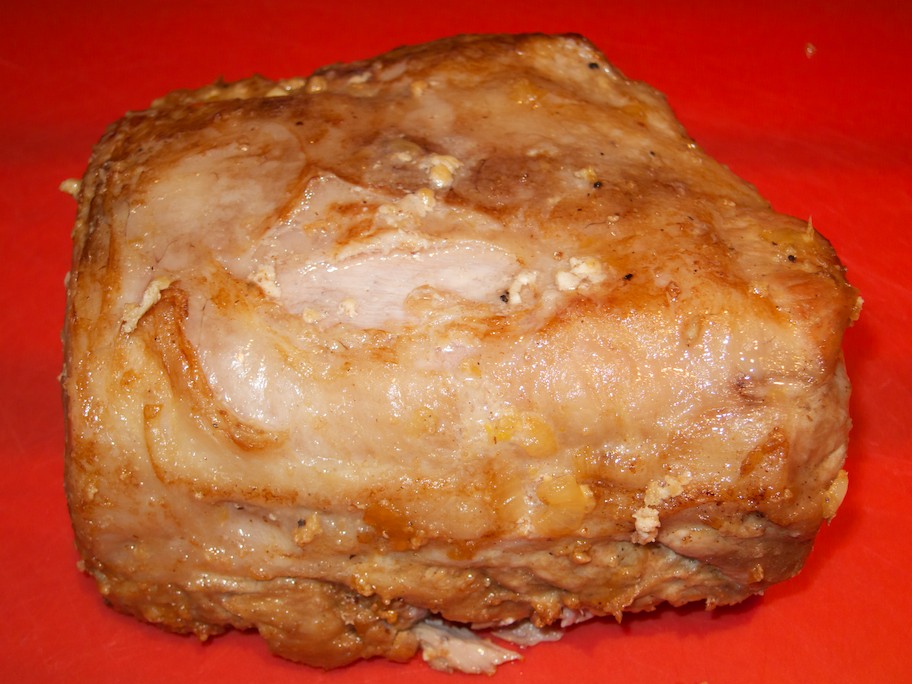
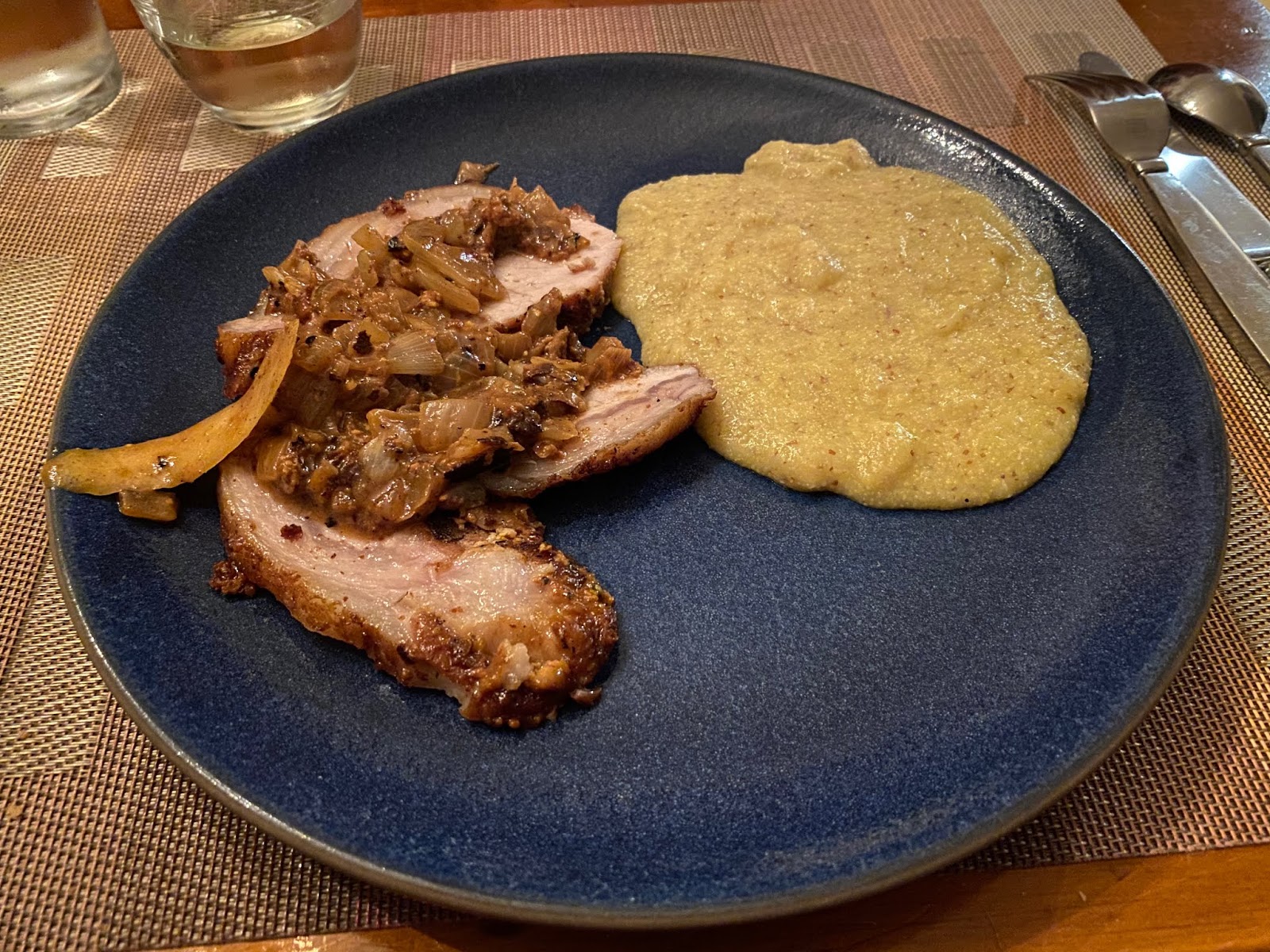
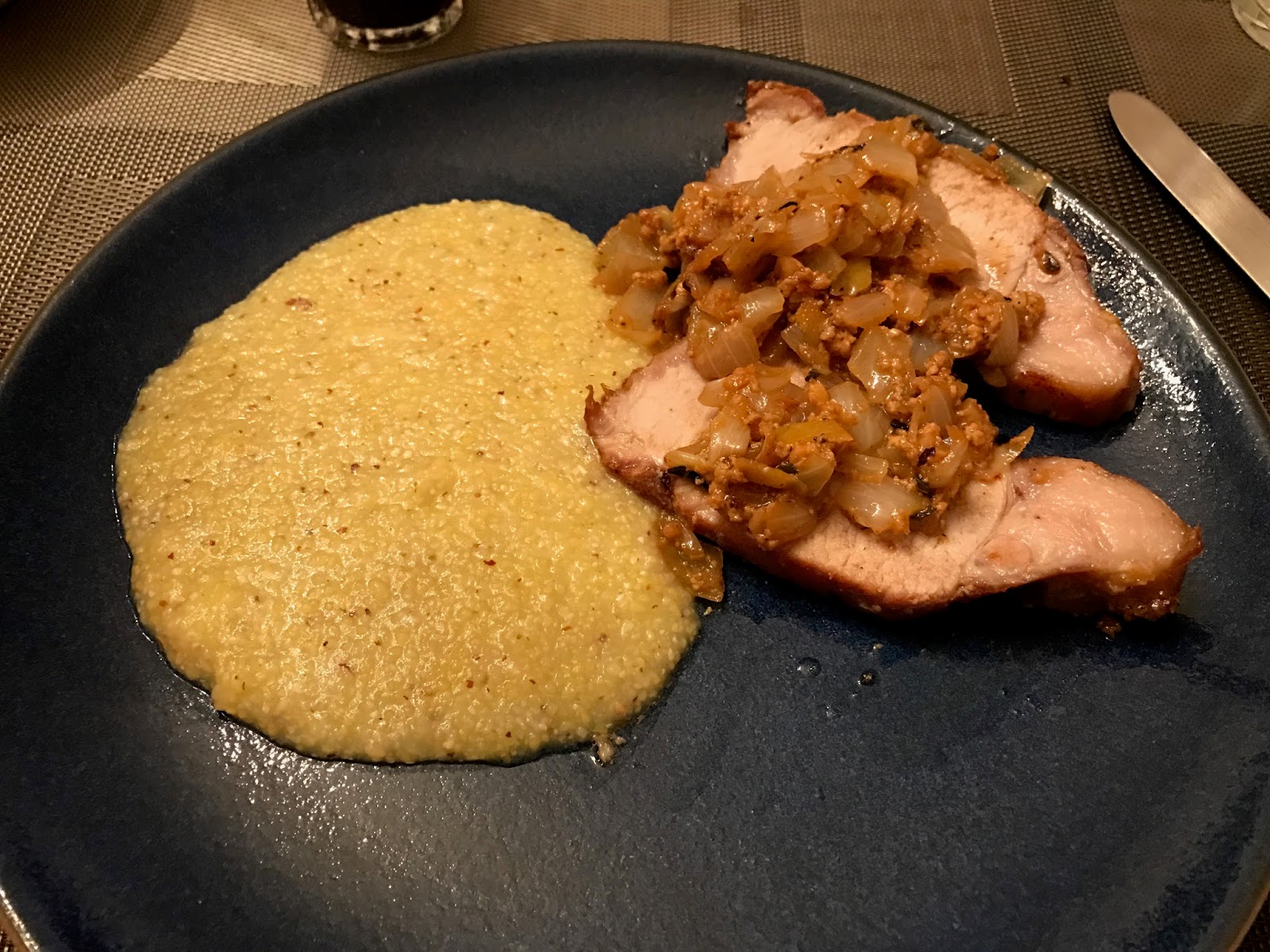
Cathy combined two recipes Pan-roasted Pork Chops with Olives and Sambuca-Braised Fennel found in our blog of March 22, 2018 (Click the date to get the recipe) and Pork al Latte with Fennel Pollen and Crispy Sage. It was a great rendition of this dish. We have made Pork Braised in Milk many times. We had recently eaten it a ChiSpacca and decided to use Nancy's recipe(s). We purchased an injector and injected brine directly into the meat to make it even more moist. We used Fennel as a side along with Polenta. This made for a great Winter meal.

Pork al Latte with Fennel Pollen and Crispy Sage
Chi Spacca Cookbook
Serves 4 to 6
 
For the Pork
1 center-cut pork loin (about 4 pounds)
1½ teaspoons kosher salt
1½ teaspoons sugar
1 recipe Fennel Rub (page 20)
2 lemons
1½ cups whole milk, plus more as needed
2 medium shallots, peeled and sliced ¼ inch thick lengthwise
2 bay leaves (preferably fresh)
 
For the Sage
2 cups olive oil, or as needed
½ cup fresh sage leaves
½ teaspoon kosher salt
 
For Serving
1 tablespoon fennel pollen
 
Pork braised in milk is a classic Italian preparation and results in juicy, flavorful meat. There is lemon in the braising liquid, and the combination of the milk with the acid causes the milk to form curds. Ryan likes to say it looks like a failed culinary school assignment, but i think the pillowy curds look pretty in a very rustic way. This recipe calls for a pork loin, a large cut of meat that becomes tender when braised; this is not to be confused with the smaller, thinner tenderloin, which should be grilled or seared, rather than slow cooked.
 
We brine this roast before grilling it. Brining refers to infusing meat with a solution usually consisting of water and either salt or a combination of salt and sugar. You can brine meat by soaking it in the solution or by injecting the solution into the meat. (We do the latter.) Brining tenderizes the meat, makes it juicier, and also seasons it on the inside. It is especially important with thick cuts of meat where the seasoning on the outside will have no effect whatsoever on the inside, and pork in particular, which can tend to be dry. To brine this roast, you will need a flavor injector, an inexpensive gadget that is available wherever cooking supplies are sold. The finished pork is seasoned with fennel pollen, a fragrant powder harvested from wild fennel in the hillsides of Tuscany and Umbria. You can find it at specialty food markets and online sources.
 
Ask your butcher for a (4-pound) bone-in pork loin roast with a nice fat cap. Pork loin does not have much marbling of fat in it, so the fat cap is essential.
 
You will need an extra-large platter to serve the pork on.
 
To prepare the pork, place it in a large baking dish or on a baking sheet.
Combine the salt, sugar, and ¼ cup water in a small bowl to make a brine and whisk to dissolve the salt and sugar. Fill the flavor syringe with the brine. Entering through the side of the roast, inject half of the brine deep into the center of the roast. Remove the syringe and inject the remaining brine deep into the roast through the other side. Pat the roast dry with paper towels. Reserve 2 teaspoons of the fennel rub and sprinkle the remaining rub evenly over the pork. Use the meat to mop up any fallen rub and press the rub into the meat with your hands to adhere. Set aside for 30 minutes to 1 hour to let the seasonings penetrate the pork and for the pork to come to room temperature.
 
Adjust the oven rack to the center position and preheat the oven to 325°F.
Cut off and discard the top and bottom of the lemons at the point where you can see the flesh. One at a time, place the lemons upright on a cutting board and cut down the sides at the point where the pith meets the flesh,
following the natural curve of the fruit to remove the pith along with the peel. Discard the pith and peels. Turn the lemons on their sides and cut along one of the membranes toward the center of the fruit. Working your way around the lemons, cut along both sides of each membrane to
release all the segments from the cores.
 
Combine the lemon segments, milk, shallots, bay leaves, and the reserved 2 teaspoons fennel rub in a large Dutch oven and stir to combine. Place the pork in the Dutch oven and add more milk if needed to come halfway up the sides of the pork. Warm the milk over medium-high heat until begins to bubble around the edges, about 5 minutes. Turn off the heat.
 
Roast the pork in the oven for 45 minutes to 1 hour, until an instant-read temperature registers 125°F when inserted deep into the side of the pork. Remove the pork from the oven and set aside for 10 to 20 minutes to allow the pork to rest and for the milk to form curds as it cools.
 
While the pork is braising, to fry the sage, pour enough oil into a small saucepan
to fill it 1½ to 2 inches deep. Fasten a deep-fry thermometer, if you have one, to the side of the pan and heat the oil over medium-high heat until the thermometer registers 350°F or a pinch of salt sizzles when dropped into the oil. While the oil is heating, create a bed of paper towels and have a slotted spoon or mesh strainer handy. Turn off the heat, add the sage leaves, and fry for about 30 seconds, until the leaves are crispy but not brown. Use the slotted spoon or strainer to lift the sage leaves out of the pan and transfer them to the paper towels to drain. Sprinkle with the salt. Let the oil cool and strain it into a container; cover and reserve the oil to cook with another time.
 
Remove the pork loin from the Dutch oven and place it on a cutting board with the bones facing up.
 
Using a slotted spoon, gently scoop the curds out of the pan, letting the liquid drain for a few seconds before gently dropping the curds onto an extra-large platter. When you have harvested all of the curds, slice the pork. With your knife parallel to and resting alongside the rib bones, slide your knife down the bones to release the loin, leaving as little meat on the bones as possible. Slice the loin ½ inch thick. Slide your knife under the slices and lay them fanned out over the curds so the curds are peeking out around the slices. Cut between the rib bones and pile them on the platter for people to gnaw on. Drizzle the liquid left in the pan over and around the pork slices and bones to moisten them. Sprinkle Sprinkle the fennel pollen and scatter the sage leaves over the pork.

Monday, October 17, 2011

Pork Braised with Milk and Two Types of Polenta


Pork with Polenta
The other Polenta

It is getting cool in Los Angeles and it was appropriate for us to cook one of our favorite pork recipes: Pork Braised in Milk from . If you have never made this dish, or if you are not a cook this is the dish for you! This is a no fail, easy, delicious, surprising dish.

Pork Braised in Milk and Polenta

This was one more dinner we made in the post holiday vacation. This is one of our all-time favorites. It was one of the first dishes that we jointly made, years ago. It sounds weird to braise pork in milk, but is an excellent preparation. The milk eventually boils off, creating a dark thick sauce as it combines with the pork drippings during cooking. The recipe we use is from Marcella Hazan: The Classic Italian Cookbook. Matt Molina who used to cook at Campanile, and now is the executive chief at Mozza, served it once and made an addition that we have incorporated. He added sautéed onions, garlic, lemon peel and sage to the recipe. It was a good addition to the recipe.

1. 2 tablespoons butter
2. 2 tablespoons vegetable oil
3. 2 pounds boneless pork loin, with some fat on it
4. 1 teaspoon salt
5. freshly group pepper
6. 2 ½ cups milk
7. 2 chopped onions sauted with chopped garlic and sage leaves and lemon peel

Use a casserole pan slightly larger then the pork. Heat the butter and oil and brown onions 1 or 2 chopped garlic cloves some fresh sage leaves and lemon peel. When golden remove from pan.

Add the pork and on a medium high heat braise on all sides till brown. Reduce the heat and slowly add the milk and salt and pepper. Bring to boil then reduce heat to medium and cover with lid slightly open. Cook 1 ½ to 2 hours turning the meat every 30 minutes. By the time the meat is cooked, the milk should have evaporated, leaving a brown nutty sauce. Remove the pork and add the onion and garlic to the sauce in the pan and heat.

Let the meat slightly cool, slice and serve with sauce.

We have always read about what is supposedly the best polenta in the world (other than our cat named Polenta). It is from Anson Mills in South Carolina. We finally bought several bags of the Polenta and this is the first time that we had used it. It is good, and has a rougher texture than the traditional Italian Polenta that we use. We recommend it. 

Friday, January 05, 2007

Leftovers and More


French Onion Soup

For a first course, since it was winter and getting cool (at least by LA standards), we made French Onion Soup. We always use Julia Child’s recipe. It is very rich with lots of beef broth and cheese. We usually grate the Gruyere Cheese over toast in the soup then broil the cheese. We decided to perform an experiment and grated the cheese on one of the bowls of soup. For the other bowl we thinly sliced the cheese and put it on the soup. What we discovered was that it made no difference once the cheese melted. So, since it is easier to slice then grate, we will slice the cheese in the future.

Lobster Pasta


We wanted to use the leftover Lobster from New Years. We had this incredibly rich lobster butter that we had used to poach the lobster. We had saved the butter and knew we would be re-using it. We made pasta and then melted the butter, and added the lobster. It was very rich and wonderful.

Smoked Salmon Spread

We had smoked salmon and made a salmon spread that we have always liked.
We first found it in the Los Angeles Times. It is very easy to make.

Salmon Spread


8 oz smoked salmon cut up
2 tbl chopped onion
1 tsp chopped drained capers
2 tbl sour cream
1 tsp lemon juice or to taste

Mix and serve on crackers or toast points


Pork Braised in Milk and Polenta


This was one more dinner we made in the post holiday vacation. This is one of our all-time favorites. It was one of the first dishes that we jointly made, years ago. It sounds weird to braise pork in milk, but is an excellent preparation. The milk eventually boils off, creating a dark thick sauce as it combines with the pork drippings during cooking. The recipe we use is from Marcella Hazan: The Classic Italian Cookbook. Matt Molina who used to cook at Campanile, and now is the executive chief at Mozza, served it once and made an addition that we have incorporated. He added sautéed onions, garlic, lemon peel and sage to the recipe. It was a good addition to the recipe.

1. 2 tablespoons butter
2. 2 tablespoons vegetable oil
3. 2 pounds boneless pork loin, with some fat on it
4. 1 teaspoon salt
5. freshly group pepper
6. 2 ½ cups milk
7. 2 chopped onions sauted with chopped garlic and sage leaves and lemon peel

Use a casserole pan slightly larger then the pork. Heat the butter and oil and brown onions 1 or 2 chopped garlic cloves some fresh sage leaves and lemon peel. When golden remove from pan.

Add the pork and on a medium high heat braise on all sides till brown. Reduce the heat and slowly add the milk and salt and pepper. Bring to boil then reduce heat to medium and cover with lid slightly open. Cook 1 ½ to 2 hours turning the meat every 30 minutes. By the time the meat is cooked, the milk should have evaporated, leaving a brown nutty sauce. Remove the pork and add the onion and garlic to the sauce in the pan and heat.

Let the meat slightly cool, slice and serve with sauce.

We made polenta to serve as a side with the pork. For this version of polenta we had purchased truffle butter and added it to the polenta. It was unbelievably fragrant. It made the polenta very special.

We took the leftover and make a casserole with it. Take a large ceramic dish, butter and then layer with polenta, sliced pork, the sauce, more polenta. When ready to serve top with grated parmesan and bake at 350 till sizzling.

Saturday, October 06, 2012

Rotisserie Pork


Here is a short video of the pork on the Rotisserie.


We went to a charity event: Alex’s Lemonade Stand. This is one of the premier food charity events with chefs from all over the country cooking. We had a Rotisserie Pork Sandwich that was absolutely fantastic. I decided I wanted to try making a pork roast on the rotisserie. Only problem was that I didn’t have a rotisserie.

I didn’t know exactly what to do but I decided to Google Rotisserie and Weber (we have a Weber Grill, in addition to the Egg). To my surprise, I found out that Weber made a Rotisserie Attachment. I ordered it via Amazon and it promptly arrived. I had never used one, and I then Googled “rotisserie” to get some ideas how to best use it.

We coated the pork with Fennel Rub that Mozza2Go sells. It is an excellent choice for pork. The key was cooking by an indirect method, without having the coals directly under the pork, low and slow. We studded the pork with slivered garlic and placed it on the spit. It actually is easier to use a rotisserie then to grill, because you don’t have to watch it as closely. Simply have an estimate of how long the pork should take per pound (about 20 minutes) and occasionally glance at the rotisserie to make sure the coals were still hot adding more if needed. When the allotted time was up we checked the temperature with an instant read meat thermometer, and continued to cook until the pork reached the temperature we were looking for (about 160).

It was great! We look forward to rotissering lamb and chicken in the future.

We invited Tom and Bea to join us for the dinner. We started with a new recipe for us: Mascarpone-Parmesan Polenta from the The Balthazar Cookbook by McNally, Nasr, Hanson. Because the pork took longer to cook then we expected, we served the polenta as a first course. I thought (especially when we re-heated the polenta) that it had a slightly sour taste that I didn’t particularly like. I don’t think we will make it again. The dinner, was a huge success we all loved the pork. With the pork we served Cauliflower that we bought at Forage. For dessert we had an absolutely amazingly rich Chocolate Carmel Tart from Proof. Boy was it good! 

It was an amazing night. Perfect.

For some people, polenta will only ever taste as good as what comes with it. But this version, with mascarpone and Parmesan, can stand on its own, as well as complement most meat dishes. The basic technique yields soft polenta, to be served in mounds; frying or grilling it produces firm pieces. Grilled polenta requires chilling, so start well in advance.

SERVES   6

2         cups Chicken Stock
2         cups whole milk
2         cups half-and-half
2         cups dry cornmeal polenta
8         tablespoons (1 stick) unsalted butter, cut in pieces
1         cup mascarpone
1/2  pound grated Parmesan (about 1 cup)
1/4  teaspoon salt
1/8  teaspoon freshly ground black pepper

Bring the stock to a boil in a saucepan. Keep warm over a medium flame.

In a medium saucepan, bring the milk and half-and-half to a foamy simmer. Reduce the flame to medium and add the polenta to the foaming milk mixture, stir­ring continuously. When the mixture begins to thicken, begin adding the hot stock, 1/2 cup at a time. As with risotto, let the stock absorb completely before adding the next 1/2 cup, stirring all the while.

When all of the stock has been added, reduce the flame to low and add the butter, mascarpone, and Parmesan, stirring well to blend. If the consistency overall is too thick, add a bit of milk or stock. Stir in the salt and pepper.

Spoon-serve immediately or grill in the following manner: Spread the soft polenta in a buttered casserole dish or sheet pan and refrigerate for at least 4 hours, or overnight. Cut 3-inch circles from the cooled pan and either pan-fry in 2 tablespoons of oil or grill, lightly brushed with oil.


Monday, May 09, 2016

Pork Braised in Milk


I love Pork Braised in Milk. The milk curdles and becomes a flavorful gravy as it condenses and blends with the natural fluids from the pork. This is a super easy dish and the leftovers make great sandwiches. We served the pork over Polenta with the thickened milk / pork gravy on top. Yum! You can get the recipe from our blog of: October 17, 2011. Click the date to get the recipe.


We started with an Asparagus Salad from a new recipe we found in The New York Times. I never would have thought of a Strong Mustard Vinaigrette over the Asparagus, but it is a great recipe.

Asparagus With Mustard Vinaigrette
New York Times

Here is an easy, springtime recipe that takes no time at all and puts the light flavors of the season right onto your table. Cooking time is key: both the asparagus and the eggs must be watched carefully. Arrange everything on a plate beautifully, and throw open the windows to spring.

INGREDIENTS
1-½         pounds large or medium asparagus
4         large eggs
1         small shallot, finely diced
2         tablespoons red wine vinegar
Salt and pepper
2         tablespoons Dijon mustard
¼         cup extra-virgin olive oil
1         tablespoon finely cut chives

PREPARATION

1.   Snap off and discard the tough bottoms of each asparagus spear. If using large thick asparagus, peel the lower ends with a vegetable peeler. Medium asparagus will not need peeling.
2.   Bring a medium saucepan half filled with water to a boil, carefully add the eggs and simmer briskly for 9 minutes (10 minutes for a slightly firmer yolk). Transfer the eggs to a bowl of ice water to cool. Shell the eggs and set aside.
3.   Make the vinaigrette: In a small bowl, place the shallots, vinegar and a pinch of salt. Let shallots soften for 5 minutes. Stir in the mustard to dissolve, then whisk in the olive oil to make a thick dressing. Season to taste with salt and pepper.
4.   In a large stainless-steel soup pot bring 4 quarts of well-salted water to a rolling boil. Add the asparagus and cook for 3 to 5 minutes, until just done. Remove asparagus with a large strainer and spread out on a baking sheet lined with a clean kitchen towel. Asparagus may be served warm or at room temperature.
5.   To serve, place asparagus on a platter or individual plates. Spoon the vinaigrette over the asparagus. Garnish with quartered eggs (or roughly chop the eggs if you prefer). Sprinkle with chives.

Monday, November 11, 2019

Pork Braised in Milk, best Polenta


This is a dish that I never get tired of. It is delicious! and the left over pork makes great sandwiches. It sounds strange to cook Pork Braised in Milk, but the milk curdles and makes a fantastic sauce. You should make this dish. With the Pork we made the unbelievably excellent Polenta that Guillermo brought us from Italy. You can get the Pork Braised in Milk Recipe on our blog of January 5, 2007. Click the date to get the recipe.

Tuesday, December 13, 2016

Pork in Milk


Pork in Milk is a wonderful standby for us. The milk curdles and makes a great sauce, the meat is boneless and leftovers slice easily making great pork sandwiches. The idea of braising Pork in Milk sounds strange but is easy and delicious. If you have never made this dish, I highly recommend it! You can get the recipe on our blog of: October 17, 2011. Click the date to get the recipe.

We serve it with Polenta, a perfect foil for the Pork. 

Monday, November 11, 2013

Pork Braised in Milk


We love pork. Pork Braised in Milk, sounds so strange, yet it has it all: Easy to make, delicious, makes for good leftovers and easy to clean up. We have made this dish many, many times. The milk curdles as it evaporates creating a nutty sauce for the pork. You can get the recipe from our blog of: Oct. 17, 2011. Click the date to get the recipe.


With the pork, we traditionally serve Polenta. In addition this time we added a dish that we had at Chi Spacca: a Fennel Gratin. We liked this dish and will make it again.

Sunday, April 18, 2010

Food Memory


Wine:

Vouvray – Sebastien Brunet
Domaine La Bastide Roussanne 2008
Chateau d”Arsac Margaux 2004
Sequoia Grove Cabernet Sauvignon Napa Valley 2005
Vouvray 2005 Demi-Sec


When we lived in San Francisco many years ago we used to eat at an Asian Restaurant named Monsoon. Its chef / owner Bruce Cost served delicious food. One of our strongest food memories was of a dish he called: Scallops and Fresh Water Chestnuts in Thai Pork Sauce. He published the recipe in his cookbook Asian Ingredients.

We have never made it because we couldn’t find fresh Water Chestnuts. We went out for a Chinese dinner in Monterey Park and stopped at huge Chinese Market: Ranch 99. They had fresh Water Chestnuts and we immediately remembered the dish and decided to make it. We knew McCall’s Meat and Fish would be able to get us perfect scallops. Near us is a wonderful spice store: Spice Station Silverlake where we bought lots of fresh spices for the dish. I had never worked with Water Chestnuts and didn’t know how hard they would be to clean, peel and cut. Turns out it was easy. The dish turned out exactly as we remembered it. It is fantastic. We will definitely make it again. Unfortunately for us there was no leftovers!

We served Indian Candy and Smoked Mussels with wine when our guests arrived. We get the Salmon and Mussels from Santa Monica Seafood. The fish store is one of the few reasons to leave the 323 area code for the 310.

We started with another dish from the same cookbook: Asparagus with White Miso Vinaigrette. This Japanese inspired dish is served at room temperature and was a perfect match for the curry.

Alan brought a delicious Mango Cake from a Japanese bakery in downtown Los Angeles: Frances Bakery. It was amazingly light in texture.

We also served Danish Cookies from the new Danish Bakery in downtown Los Angels: Hygge Bakery. The cookies were great.

The dinner started at 7:30 and didn’t end until midnight.


Scallops and Fresh Water Chestnuts in Thai Pork Sauce
From Asian Ingredients by Bruce Cost

Scallops and water chestnuts complement each other in shape and texture. A meal can be made of this rich, spicy dish with the addition of just rice and a simple green salad.

Yield: 6 to 8 servings


6 to 8 fresh water chestnuts (or canned if necessary)
1 pound fresh sea scallops
2 teaspoons cornstarch
Few drops sesame oil
1 teaspoon cumin seeds
2 teaspoon fennel seeds
1 teaspoons coriander seeds
1 tablespoon minced fresh ginger
1 teaspoon minced fresh turmeric (if available)
4 garlic cloves, minced
4 small fresh red chilies, minced (including seeds)
1 stalk lemongrass (bottom third only), finely minced
3/4 cup unsweetened coconut milk
1/2 cup water
Juice of 1 large lime
3 tablespoons fish sauce
1 1/2 teaspoons sugar
Pinch of salt
1 cup plus 3 tablespoons peanut oil
1/2 pound ground pork
1/4 cup coriander leaves

Wash the mud from the water chestnuts, peel them, cut them in half, and put them in a bowl of cold water until ready to use.

Rinse the scallops and cut them in half. Toss with the corn¬starch and sesame oil, and refrigerate until ready to cook.

Toast the seeds in a small dry skillet until fragrant; then grind them in a mortar or spice grinder and set aside. Combine the ginger, turmeric, garlic, chilies, and lemongrass in a small bowl and set aside. Mix the coconut milk, lime juice, fish sauce, sugar, and salt together, and set aside.

Heat 3 tablespoons of the oil in a skillet and add the pork. Cook, stirring to separate the grains. When the meat has changed color—it shouldn't brown—add the ground spices and' stir for 30 seconds. Add the another 30 seconds. Add the seasoned coconut milk, stir to blend, then add the water and bring to a boil. Turn the heat to medium-low and cook for 8 to 10 minutes, stirring from time to time, until it just begins to thicken. Add more water if necessary while you cook. Turn off the heat, cover, and set the sauce aside, (it may be prepared an hour or so ahead.)

Heat the remaining 1 cup oil in a wok, and when it is hot add the scallops, stirring to separate. Cook for 30 seconds, then re¬move with a slotted spoon and drain. Drain the water chestnuts and cook them in the hot oil for 15 seconds; remove with a slotted spoon.

Reheat the pork sauce. Add the scallops and water chestnuts and stir over high heat just until hot. Turn off the heat, garnish with the coriander, transfer to a serving platter, and serve.

Asparagus with White Miso Vinaigrette
From Asian Ingredients by Bruce Cost

Japanese salads, aemono ("dressed things"), use a wide range of vegetables, raw and parboiled, and seafood, cooked or uncooked. The dressings are flavorful and often tangy, like the all-purpose one here, which is tossed with asparagus. The white miso and mustard combination is superb.
Yield: 4 servings

2 teaspoons mustard powder
2 teaspoons cold water
1 pound thin asparagus
1 egg yolk
2teaspoons white miso
2 teaspoons Japanese soy sauce
1 tablespoon fresh lemon juice
1 tablespoon white rice vinegar
2 tablespoons minced scallions (white part only)

Mix the mustard powder and water together to form a thin paste. Allow it to sit for 10 minutes.

Cut the asparagus diagonally into thin slices about 1 inch long. Cook the asparagus slices in boiling water until barely ten¬der, 1 1/2 minutes or so. Then run under cold water to stop the cooking. Drain and set aside.

Vigorously mix the egg yolk with the mustard. Then stir in the remaining ingredients in order, and allow to sit at least 10 minutes before tossing with the asparagus. Serve at room temperature.

Monday, March 07, 2016

Mushroom Soup and Pork Chops


Shumon had just returned and a craving for pork. Need I say more? We started with a delicious Porcini Mushroom Soup in The Splendid Table Cookbook. This is a great soup. We will definitely make it again.

We also decided to make a new recipe from The New York Times: Cabbage and Potato Gratin. We love all gratins. This was an excellent one.

We had purchased beautiful Pork Chops from McCall's Meat and Fish. We first seared them on a griddle on the stove then popped into the oven. This was a new recipe for us and it is excellent: Porchetta Pork Chops. We will definitely make it again! It was a wonderful welcome back dinner.


Soup of Porcini Mushrooms Zuppa dei Funghi Porcini
The Splendid Table
Lynne Rossetto Kasper

This is a big, full-flavored soup, yet it is amazingly light. Dried porcini and cultivated mushrooms replace the fresh porcini used in Parma hill country.

(Serves 6 to 8 as a first course, 3 to 4 as a main dish)

½ to 2/3 cup (1/2 ounce) dried porcini mushrooms
1-1/2 cups hot water
1       tablespoon extra-virgin olive oil
1       medium onion, minced
1       large clove garlic, minced
6       large fresh basil leaves, or 3/4 teaspoon dried basil
2       tablespoons minced Italian parsley
8       ounces white button mushrooms, thinly sliced
½      cup dry white wine
1       tablespoon imported Italian tomato paste
7       cups Poultry/Meat Stock
3       tablespoons dry white wine
6       tablespoons dry Marsala
2       tablespoons heavy cream

Method

Working Ahead: The soup can be prepared 1 day ahead, but do not add the Marsala and cream. Cool, cover, and refrigerate. Bring it to a gentle bubble before serving, stir in the Marsala and cream, and ladle into bowls.

Preparing the Porcini:

If the mushroom pieces are large, rinse them under cold running water to rid them of sand and grit. If the pieces are small, drop them into a bowl of cold water and quickly swish them around; then allow a few seconds for the particles to settle, and scoop the mushrooms out of the water. Repeat several times if the mushrooms are still sandy. Put the rinsed mushrooms in a small bowl and cover with the hot water. Let stand 20 to 30 minutes. Then scoop them out of the water and finely chop. Reserve the soaking liquid.

Preparing the Base:

Heat the olive oil in a 6-quart pot over medium-high heat. Stir in the onion, garlic, basil, parsley, and both mushrooms. Turn the heat to low, cover the pot, and cook the mixture 30 minutes, stirring occasionally. The vegetables will be wilted and aromatic.

Cooking and Serving:

Have soup dishes warming in a low oven. Line a strainer with paper towels, and strain the reserved mushroom soaking liquid over the vegetables. Add the 1/2 cup wine and the tomato paste. Bring the liquid to a boil and cook down, uncovered, 5 minutes, or until reduced by about half. Stir in the stock, and adjust the heat so the soup bubbles very slowly. Cover and cook 30 minutes. Then add the 3 tablespoons wine and simmer for 1 minute Stir in the Maisala and cream. Serve right away.

Cabbage and Potato Gratin
The New York Times

Like slow-cooked onions, slow-cooked cabbage takes on color, becoming meltingly tender and sweet. Because of the bulk of the potatoes, this gratin makes a satisfying vegetarian main dish, though it certainly works just as well as a side.

INGREDIENTS
Salt
1       large savoy or green cabbage (about 2 pounds), quartered
1       pound baking potatoes, such as russets, peeled and sliced
2       garlic cloves, peeled
2       cups milk
½      cup crème fraîche
Ground black pepper
4       ounces Gruyère, grated (1 cup, tightly packed)
1       ounce Parmesan, grated (1/4 cup)
2       teaspoons finely chopped or slivered fresh sage

PREPARATION
1.   Bring a large pot of water to a boil, salt generously and add quartered cabbage and potato slices. Reduce heat to medium-high and boil gently for 5 minutes.

2.   Drain and use tongs to transfer cabbage quarters to a colander set over a bowl or in the sink. Allow cabbage to cool in colander until you can handle the wedges. Core the wedges, then cut them in half lengthwise. Finally, slice crosswise into 1/2-inch-wide ribbons. Return to colander and drain for another 5 minutes. Place in a large bowl with the potatoes.

3.   Heat oven to 375 degrees. Butter a 3-quart baking dish or gratin. Cut one of the garlic cloves in half and rub the dish with the cut surface. Then slice up all the garlic and toss with cabbage and potatoes.

4.   In a bowl, whisk together milk, crème fraîche, about 1 teaspoon salt and the pepper. Pour into bowl with cabbage and potatoes, add cheeses and sage, and gently toss together. Scrape into baking dish.

5.   Bake 1 hour 15 minutes to 1 hour 30 minutes, until top is golden brown. During the first 45 minutes, press the vegetables down into the liquid in the baking dish every 10 to 15 minutes, using the back of a large spoon. The gratin will still be bubbling when you remove it from the oven, and you will see liquid in the baking dish. Wait 10 to 15 minutes before serving, until liquid is reabsorbed. If liquid remains in dish, serve with a slotted spoon.


Porchetta Pork Chops
New York Times

Here's a more manageable version of the traditional Italian recipe for whole roast pig seasoned with a garlic, rosemary and fennel. This one comes together so quickly, you can make it on a whim.

INGREDIENTS

2 bone-in pork chops, 1 1/4 to 1 1/2 inches thick
1 teaspoon coarse kosher salt, plus a pinch
1 lemon
2 garlic cloves, minced
2 tablespoons chopped rosemary
Large pinch red pepper flakes
½ teaspoon fennel seeds, lightly crushed
2 tablespoons chopped fennel fronds, more for garnish
2 tablespoons olive oil

PREPARATION

1.   Heat oven to 350 degrees. Pat pork chops dry and, using a very sharp paring knife, cut a large pocket into the fat-covered edge of each chop. Season chops all over with 1 teaspoon salt, including inside pockets.
2.   Finely grate zest from lemon and put in a small bowl. Cut lemon lengthwise in quarters for serving.
3.   Using a mortar and pestle or the flat side of a knife, mash garlic with a pinch of salt until you get a paste. Add to the bowl with the lemon zest and stir in rosemary, red pepper flakes, fennel seeds, 2 tablespoons fennel fronds and 1 tablespoon olive oil.
4.   Divide filling between pork chops, stuffing some inside pockets and rubbing the rest on the outside.
5.   Heat a large ovenproof skillet over high heat and add 1 tablespoon olive oil. Sear pork chops on one side for 5 minutes, or until golden brown. Gently turn over chops and cook for another minute, then transfer skillet to oven. Cook until meat is just done, about 5 to 10 minutes longer (internal temperature should read 135 degrees on a meat thermometer). Transfer pork chops to a plate, tent with foil, and let rest for 10 minutes before serving. Garnish with fennel fronds and lemon wedges.