Sunday, June 12, 2016

Chicken Pilaf


We purchased a new cookbook: Flavorwalla. With a name like that it had to have great recipes. The author has a restaurant in Bombay called: The Bombay Canteen, that we have never been to, but on our next trip we will be sure to eat there. For our first recipe from the book we decided to make: Chicken Pilaf. Cathy halved the recipe and it still made enough for a Punjabi wedding! The rice is wonderful with all of its flavors. The leftovers (and we had lots) re-heated easily and were excellent.


Chicken Pilaf
Flavorwalla
Floyd Cardoz

This is a great meal for a crowd that can be pulled together quickly using pantry and freezer staples. Make sure that your liquid is hot before you add it to the rice, so that it will cook more evenly, and stir the rice very gently with a silicone spatula to keep the grains whole.

serves 12

2      13.5-fluid-ounce cans Chaokoh-brand coconut milk (stir well before using)
About 6-1/2 cups Chicken Stock
½     cup canola oil
2      teaspoons cumin seeds
1      2-inch piece cinnamon stick
6      whole cloves
4      cups finely chopped white onions
¼     cup minced peeled fresh ginger
6      garlic cloves, minced
2      tablespoons coriander seeds, finely, ground
1      tablespoon black peppercorns (optional)
2      teaspoons turmeric
2      bay Leaves
6      cups white basmati rice, rinsed, soaked, and drained
3      pounds/1.36 kilograms boneless, skinless chicken thighs, excess fat removed, quartered
Kosher salt
1 cup thinly sliced wished and dried cilantro Leaves with tender stems (stack the Leaves a few at a time to slice), plus more for garnish

Pour the coconut milk into a large glass measure. Add enough stock to make 2-1/2 quarts. Heat the stock and coconut milk in a medium pot over medium-high heat until boiling. Reduce the heat and keep at a very low simmer.
In an 8-quart stew pot with a tight-fitting lid, heat the oil over medium heat until it shimmers. Add the cumin, cinnamon, and cloves and cook, stirring, until the spices are fragrant and little bubbles form around them, about 1 minute. Add the onions and cook, stirring, until softened but not at all colored, about 3 minutes.

Use a silicone spatula to stir in the ginger, garlic, coriander, black peppercorns, if using, turmeric, bay leaves, and the drained rice, then stir to coat the rice with the oil and spices. Stir in the chicken, tucking it into the rice, and stir over medium heat for 3 minutes.

Stir in the hot stock mixture and bring to a boil, stirring occasionally. Season to taste with salt. Cover and cook over medium heat until all the liquid is absorbed and the chicken is cooked, 15 to 20 minutes. Fold in the cilantro. Cover and let the rice rest for 15 to 20 minutes.

Fluff the rice with a fork; remove and discard the cinnamon stick, cloves, and bay leaves. Sprinkle with the chopped cilantro and serve.

Cooking Time: about 55 minutes/ inactive time: 15 to 20 minutes for resting


Tuesday, June 07, 2016

Jar-B-Que


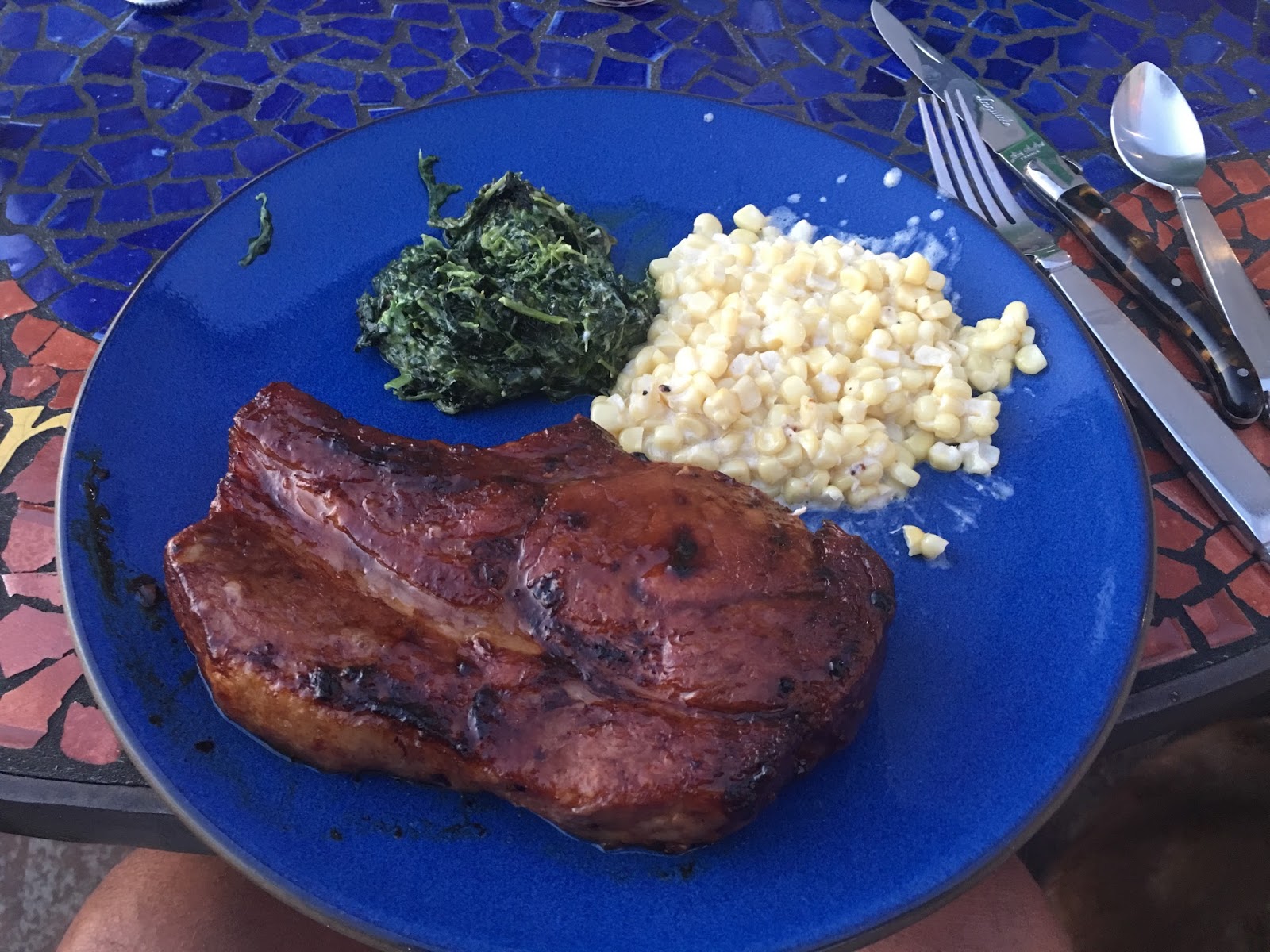
We call the Pork Chops recipe from Jar: Jar-B-Que. They call it Hosin-Marinated Pork Chops. No matter, it is excellent. We purchased beautiful pork chops from McCall’s Meat and Fish. We have made the recipe many, many times. You can get the recipe from our blog of: July 30, 2012. Click the date to get the recipe.


With the Pork Chops we had Creamed Corn  and Spinach, which was a leftover from an excellent dinner that we had at Terrine. Corn is just coming into season and it was very excellent. You can get the recipes for both the Hosin-Marinated Pork Chops and the Creamed Corn from our blog of: Sep. 16, 2013. Click the date to get the recipe.

Saturday, June 04, 2016

Salmon with Gribiche


We have been eating a lot of salmon and we found a recipe for Sauce Gribiche in Thomas Keller's French Laundry Cookbook. It was delicious. It has all of the tastes of Provence that I love! We served the Salmon with steamed Potatoes. An excellent meal.

Thomas Keller

This sexy little number comes straight out of the French Laundry cookbook. Normally I wouldn’t reprint a recipe from a such a tome, just out of respect, however you can quite easily find this recipe via a quick google search – thanks to google books. So here goes.
This sauce is fantastic with anything that is rich and fatty – pork belly, leg of lamb – heck it might even work with some great black cod or salmon.

1       heaped tablespoon minced shallot
1-1/2 teaspoon finely minced capers
1-½   teaspoon finely minced cornichon
½      teaspoon Dijon mustard
1       tablespoon of wine vinegar or sherry vinegar
¼      cup extra virgin olive oil (use some good stuff)
1       heaped tablespoon of finely chopped hard boiled egg white
1       tablespoon of finely chopped hard boiled egg yolk
¼      teaspoon finely minced tarragon
1       teaspoon finely minced flat leaf parsley
½      teaspoon finely minced chives

Mix all ingredients in a bowl. Personally I like to mix the wet and add the dry in. I also like to make this a few hours before required, just to let the flavors develop a bit.

Serve alongside the roast potatoes, or with the potatoes sitting on top of a pool of the gribiche.

Wednesday, June 01, 2016

Yakisoba


We purchased delicious fresh Cherries and Nectarines at the market and started with a Fruit Salad  topped with Burrata and Balsamic Vinegar. It was super refreshing.

We had lots of left over Pork Butt Ssam, so we decided to make Yakisoba. We like all Japanese food, so this was a no brainer! You can find the recipe for the Yakisoba on our blog of: March 7, 2010. Click the date to get the recipe.

Monday, May 30, 2016

Pasta al Ceppo with Wild Mushrooms and Pork


We had lots of leftover Pork Butt. Cathy had the great idea to make a pasta sauce with it. She used a recipe from one of our favorite restaurants Campanile (now closed) for Duck Ragu but substituted the Pork Butt for the duck. It was fantastic. We also used a new a different pasta. Is is called:  Casareccia. I really like it. It has a chewy texture,e being thicker than normal pasta, and has a slit down the side allowing for more sauce to penetrate the pasta. It can be bought on Amazon (as most everything can be). 

Pasta al Ceppo with Wild Mushrooms and Duck Confit
The Food of Campanile
Mark Peel & Nancy Silverton

Serves 6

The very name of this dish would seem to epitomize fall. When this is served with a sim­ple salad of fennel and arugula, you have a com­plete and filling autumn meal. Pasta al ceppo is a I tolled sheet pasta that is shaped something like a cinnamon stick. It is more substantial in texture than penne;it holds sauce well and has a toothy bite.

12        ounces assorted fresh mushrooms (button, shiitake, chanterelle)
2         tablespoons vegetable oil
Kosher salt
Freshly cracked black pepper
2         tablespoons balsamic vinegar
¾         cup leeks, well washed and trimmed
2         large shallots, peeled, trimmed, and minced (2 tablespoons)
½         cup port
1         cup Duck Stock or Brown Veal Stock
½         teaspoon chopped fresh rosemary
½         teaspoon chopped fresh thyme
½         ounce dried porcini mushrooms, soaked for 15 minutes in 1/2  cup warm water (optional)
¾         pound dry pasta al ceppo
½         pound shredded (1 cup packed) Duck Confit

Have ready

The Duck Confit, cooked and shredded The Duck Stock or Brown Veal Stock, warm, in a small saucepan over low heat

The button mushrooms can be washed, but the shiitakes and chanterelles should be gently wiped clean with a damp kitchen towel, as washing will make them soggy. Using a sharp knife, trim the stems of the button and shiitake mushrooms. Then cut the button and shiitake mushrooms into quarters. Using your fingers, pull the chanterelles into thick shreds.

In a large saute pan, over high heat, preheat 1 tablespoon of the vegetable oil. Saute the mushrooms, turning to brown on all sides, about 5 minutes, and season lightly with kosher . salt and black pepper. Transfer the mushrooms to a medium mixing bowl and reserve. Add the balsamic vinegar to the saute pan, and cook for 1 or 2 minutes to deglaze the pan. Pour the deglazed liquid over the mushrooms in the mixing bowl, and reserve.

Wipe the saute pan clean, and over medium heat, preheat the remaining 1 table­spoon of vegetable oil. Add the leeks and shal­lots, and saute lightly, about 2 minutes. Add the port, deglaze the pan, and reduce by half, about 5 to 8 minutes. Add the stock, the rosemary, and thyme. If the dried mushrooms are to be used, add them at this point, including the soaking water, taking care to prevent any dirt from the dried mushrooms from pouring into the sauce. Reduce until the sauce thickens slightly, about 10 minutes. Season to taste with kosher salt and black pepper, and keep warm.

In a large stockpot, bring approximately 4 quarts of water to a boil, and add 1 tablespoon of kosher salt. Cook the pasta al dente, accord­ing to the manufacturer's instructions. Drain the pasta in a colander.

Add the pasta, the mushrooms, and the Duck Confit to the sauce, and stir to heat through, about 3 minutes. Correct the season­ing to taste with kosher salt and black pepper. Divide equally among 6 large, warm plates, and serve immediately.


Friday, May 27, 2016

Pork Butt (Bo Ssam)

Get Your Pork On!


We love pork in almost all its reincarnations. We saw a recipe for this Korean preparation of Bo Ssam in The New York Times. It came with rave reviews. We purchased a 10 pound Pork Butt from McCall’sMeat and Fish. Luckily we figured out we should cook it in a disposable aluminum pan - I would have hated to have to clean the pan. It was wonderful. There were two sauces that had to be made. One was the marinade, the other Ssam Sauce. The recipe is from Momofuku in New York City. They sell on the internet the Ssam Sauce. We loved the dish and the sauce, but to make our life easier we purchased the Ssam Sauce on the internet to have available for the next time we make this dish.

There was a lot of leftovers so we were able to enjoy the meat for several days.

This recipe is a keeper!


Momofuku's Bo Ssam
New York Times

This is a recipe to win the dinner party sweepstakes, and at very low stakes: slow-roasted pork shoulder served with lettuce, rice and a raft of condiments. The chef David Chang serves the dish, known by its Korean name, bo ssam, at his Momofuku restaurant in the East Village and elsewhere. He shared the recipe with The Times in 2012. Mr. Chang is known as a kitchen innovator, but his bo ssam is a remarkably straightforward way to achieve high-level excellence with little more than ingredients and time. Simply cure the pork overnight beneath a shower of salt and some sugar, then roast it in a low oven until it collapses. Apply some brown sugar and a little more salt, then roast the skin a while longer until it takes on the quality of glistening bark. Meanwhile, make condiments – hot sauces and kimchi, rice, some oysters if you wish. Then tear meat off the bone and wrap it in lettuce, and keep at that until everything’s gone.

Ingredients
Pork Butt:

1         whole bone-in pork butt or picnic ham (8 to 10 pounds)
1         cup white sugar
1         cup plus 1 tablespoon kosher salt
7         tablespoons brown sugar

Ginger-Scallion Sauce:

2 ½         cups thinly sliced scallions, both green and white parts
½         cup peeled, minced fresh ginger
¼         cup neutral oil (like grapeseed)
1 ½         teaspoons light soy sauce
1         scant teaspoon sherry vinegar
½         teaspoon kosher salt, or to taste

Ssam Sauce:

2         tablespoons fermented bean-and-chili paste (ssamjang, available in many Asian markets, and online)
1         tablespoon chili paste (kochujang, available in many Asian markets, and online)
½         cup sherry vinegar
½         cup neutral oil (like grapeseed)

Accompaniments:

2         cups plain white rice, cooked
3         heads bibb lettuce, leaves separated, washed and dried
1         dozen or more fresh oysters (optional)
Kimchi (available in many Asian markets, and online)

Preparation

1.   Place the pork in a large, shallow bowl. Mix the white sugar and 1 cup of the salt together in another bowl, then rub the mixture all over the meat. Cover it with plastic wrap and place in the refrigerator for at least 6 hours, or overnight.

2.   When you're ready to cook, heat oven to 300. Remove pork from refrigerator and discard any juices. Place the pork in a roasting pan and set in the oven and cook for approximately 6 hours, or until it collapses, yielding easily to the tines of a fork. (After the first hour, baste hourly with pan juices.) At this point, you may remove the meat from the oven and allow it to rest for up to an hour.


3.   Meanwhile, make the ginger-scallion sauce. In a large bowl, combine the scallions with the rest of the ingredients. Mix well and taste, adding salt if needed.

4.   Make the ssam sauce. In a medium bowl, combine the chili pastes with the vinegar and oil, and mix well.


5.   Prepare rice, wash lettuce and, if using, shuck the oysters. Put kimchi and sauces into serving bowls.

6.   When your accompaniments are prepared and you are ready to serve the food, turn oven to 500. In a small bowl, stir together the remaining tablespoon of salt with the brown sugar. Rub this mixture all over the cooked pork. Place in oven for approximately 10 to 15 minutes, or until a dark caramel crust has developed on the meat. Serve hot, with the accompaniments.


Wednesday, May 25, 2016

Asparagus Pasta


Spring means Asparagus Pasta. So simple, so good. Fresh Asparagus, Cheese, Pasta and Butter. What could be better?  You can find the recipe on our blog of: April 17, 2007. Click the date to get the recipe.

Monday, May 23, 2016

Expatriate Chicken


A go to dinner for us is: Expatriate Roast Chicken with Lemon and Olives from The Slow Mediterranean Kitchen by Paula Wolfert. This is a very easy chicken to cook and the Moroccan flavors are exceptional. You need Preserved Lemons which you can either buy or preserve yourself. The skin is crisp and tasty and the Olives and Preserved Lemons give it such a fabulous Moroccan flair. We love this dish. You can find it on our blog of: August 2, 2008. Click the date to get the recipe. We always serve it over Cous-Cous.

We started with a Salad of: Nectarines and Prosciutto. 


Sunday, May 22, 2016

Salmon & Cauliflower Puree


We made Salmon and served it over Cauliflower Puree. The Cauliflower Puree is a nice switch from Mashed Potatoes and went well with the salmon. We had some leftover Hasselback Potatoes that we served on the side. It made for a very tasty and good dinner. Next time you have to make Mashed Potatoes think about Cauliflower Puree. You can find the recipe for Cauliflower Puree on our blog of: Feb. 14, 2016. Click the date to get the recipe.

Thursday, May 19, 2016

Salmon and Hasselback Potato Gratin


We had left over Salmon and we decided to make a Cheesy Hasselback Potato Gratin from a recipe in The New York Times. In most gratins the potatoes are horizontal an covered with cheese and cream. In this recipe they thin slices are stacked vertically so that approximately half of the potato is directly exposed to the heat of the oven. The exposed part becomes crispy like potato chips while the submerged part is rich with cream and cheese. This is a very rich and good recipe. It is made much easier if you have a food processor with a slicing blade that can quickly cut uniform potato slices. The salmon was delicious, we served it at room temperature over a salad.

Cheesy Hasselback Potato Gratin
New York Times

This golden and glorious mash-up of potato gratin and Hasselback potatoes, from the acclaimed food science writer J. Kenji López-Alt, has been engineered to give you both creamy potato and singed edge in each bite. The principal innovation here is placing the sliced potatoes in the casserole dish vertically, on their edges, rather than laying them flat as in a standard gratin, in order to get those crisp ridges on top. Allow extra time for the task of slicing the potatoes, for which it's helpful to have a mandoline (though not necessary, strictly speaking). And do buy extra potatoes, just in case; you want to pack the potatoes tightly and keep them standing up straight.

Ingredients

3       ounces finely grated Gruyère or comté cheese
2       ounces finely grated Parmigiano-Reggiano
2       cups heavy cream
2       medium cloves garlic, minced
1       tablespoon fresh thyme leaves, roughly chopped
Kosher salt and black pepper
4 to 4 ½    pounds russet potatoes, peeled and sliced 1/8-inch thick on a mandoline slicer (7 to 8 medium, see note)
2       tablespoons unsalted butter

Preparation

Adjust oven rack to middle position and heat oven to 400 degrees. Combine cheeses in a large bowl. Transfer 1/3 of cheese mixture to a separate bowl and set aside. Add cream, garlic and thyme to cheese mixture. Season generously with salt and pepper. Add potato slices and toss with your hands until every slice is coated with cream mixture, making sure to separate any slices that are sticking together to get the cream mixture in between them.

Grease a 2-quart casserole dish with butter. Pick up a handful of potatoes, organizing them into a neat stack, and lay them in the casserole dish with their edges aligned vertically. Continue placing potatoes in the dish, working around the perimeter and into the center until all the potatoes have been added. The potatoes should be very tightly packed. If necessary, slice an additional potato, coat with cream mixture, and add to casserole. Pour the excess cream/cheese mixture evenly over the potatoes until the mixture comes halfway up the sides of the casserole. You may not need all the excess liquid.

Cover dish tightly with foil and transfer to the oven. Bake for 30 minutes. Remove foil and continue baking until the top is pale golden brown, about 30 minutes longer. Carefully remove from oven, sprinkle with remaining cheese, and return to oven. Bake until deep golden brown and crisp on top, about 30 minutes longer. Remove from oven, let rest for a few minutes, and serve.

Tip

Because of variation in the shape of potatoes, the amount of potato that will fit into a single casserole dish varies. Longer, thinner potatoes will fill a dish more than shorter, rounder potatoes. When purchasing potatoes, buy a few extra in order to fill the dish if necessary. Depending on exact shape and size of potatoes and casserole dish, you may not need all of the cream mixture.