Monday, December 12, 2011

Cooking with Konbu


A winter night, Glazed Short Ribs, what could be better? We purchased some beautiful short ribs at McCall’s Meat and Fish. We found a really interesting recipe for the ribs in Home-Cooking with Jean-Georges. What made this recipe especially interesting is that it called for using Konbu. Konbu can be found in a Japanese grocery. It is a kind of seaweed and adds a layer of taste. The result was a great sauce and wonderful tasting meat.

With the ribs we served another Jean-Georges recipe: honey-glazed parsnips. These were wonderful. I loved the combination of lime and honey. The flavors played off each other. We don’t often make parsnips, but this is a good recipe.


glazed short ribs
Home-Cooking with Jean-Georges

I love meaty short ribs, but i don't want the fuss of browning the ribs before braising them at home. To get that same rich, caramelized flavor, I simply cook the beef with konbu. Notable for its umami, this one ingredient can deliver the same depth of flavor that comes from searing meat, I do labor over these ribs, though; at the end, I keep glazing them until they shine. Serve with Honey-Glazed Parsnips for an inspired combination.

Serves 5

3         cups dry red wine
7-1/2         pounds bone-in short ribs, separated into whole ribs Kosher salt 2 whole heads garlic, cut in half through their equators
5         large fresh shiitake mushroom caps, halved
2         carrots, peeled and chopped 2 medium yellow onions, peeled and quartered
1         small celery stalk, chopped
4-inch piece fresh ginger, peeled and sliced
1         whole allspice berries, lightly crushed
1         cinnamon stick
1         (6 x 5-inch) sheet konbu
½         small bunch fresh thyme
10-1/2         cups chicken stock,preferably homemade
6         tablespoons red wine vinegar

Preheat
Preheat the oven to 325°F

Bring the wine to a boil in a large saucepan over high heat. Boil rapidly until reduced to 1/2 cup.

Generously season the ribs on all sides with salt. Let stand for 10 minutes.

Transfer the ribs to a large roasting pan, bone side up. Scatter the garlic, shiitakes, carrots, onions, celery, ginger, allspice, cinnamon, konbu, and thyme on top of the ribs. Add the stock, vinegar, and reduced red wine. Cover the pan tightly with foil, crimping the edges around the rim of the pan. Transfer to the oven and braise until completely fork-tender, 3-1/2 to 4 hours.

Remove the ribs from the oven and carefully remove the foil. Raise the oven temperature to 375°F.

When cool enough to handle, carefully transfer the ribs to a dish. Remove and discard the bones and any bits of vegetables or herbs clinging to the meat. Set a fine-mesh sieve over a large measuring cup. Carefully pour all the liquid from the pan through the sieve; discard the sol­ids. Let stand for a few minutes, then spoon the fat from the juices, discarding the fat, or use a fat separator. Pour the juices back into the roasting pan.

Return the ribs to the pan in a single layer and straddle the pan between 2 burners. Bring the liquid to a boil, then transfer the pan to the oven. Cook, basting frequently, until the ribs are glazed with a shiny coat, 5 to 10 minutes. The glaze should be saucy and cling to the ribs, but not sticky. And you should have at least 2 cups of it remaining for the serving.

Serve the short ribs topped with the glaze.

honey-glazed parsnips
Home Cooking with Jean-Georges

to bring out the best in this snowy white root vegetable, I simmer it in honey and citrus. A little heat balances the luscious sweetness.

Serves 4

2            pounds parsnips, trimmed, peeled, and cut into 5 x 1-inch batons
2            cups fresh orange juice
½            cup fresh lime juice
½            tablespoons honey
10            tablespoons unsalted butter
Grated zest of 2 limes
½            fresh red Thai chile, thinly sliced
Kosher salt

In a large saute pan, combine the parsnips, orange juice, 1 cup water, the lime juice, honey, butter, lime zest, and chile. Season with salt, cover, and bring to a boil over medium heat. Simmer over low heat for 20 minutes. Uncover and simmer, gently stirring occasionally, until the parsnips are very tender and glazed, about 15 minutes longer.


Monday, December 05, 2011

Braised Pork Ribs with Polenta


We had a great winter meal. I decided to bake a Bread, using the very easy New York Times recipe. I have made it many times and it is impossible to screw it up! The next time, however, I will try enhancing it turning it into a multi-grain bread. I really like the La Brea Bakery multi-grain and I am going to try to replicate it. The New York Times recipe can be found in our blog of: Dec. 11, 2010. Click the date to get the recipe.

I hate to be definitive, however, if you like Polenta and we do, especially in winter, the Rustic Coarse Polenta Integral (Yellow)  available via the internet from Anson Mills is without a doubt the best we have ever had. It is very course and tasty. We served sautéed mushrooms over the polenta. We use the recipe from the Zuni Café Cookbook. You can get the recipe from our blog of: Feb. 22, 2010. Click the date to get the recipe. For the main course we served Braised Pork Ribs with Polenta, from The Splendid Table by Lynne Rosetto Kasper This is my kind of dish. I love anything with Olives and Pork. It reheats really well. Delish!


Puntine di Maiale con Polenta
The Splendid Table
Lynne Rosetto Kasper


Braised Pork Ribs with Polenta
Puntine di Maiale con Polenta
The Splendid Table
Lynne Rosetto Kasper

Mounding tender chunks of pork ribs over steaming polenta is a winter specialty from Ferrara. Tomato, olives, and basil add especially rich flavors to the meaty ribs. A thick beef chuck blade roast can be substituted with great success. With either mvat, this dish evokes snug evenings in Ferrara farmhouses, when everyone gathers around the big kitchen table for hours of good talk and good food. Serve this on the first really cold night of winter, if possible in front of an open fire.

The Ferrarese claim that their pleasure in polenta comes from their proximity to the cornmeal-loving Veneto region. Just across the Po River, the Veneto is a long stone's throw from downtown Ferrara. Polenta with braisings like this one, often made with salt cod instead of pork, are eaten all across the Veneto plain.


Serves 6 to 8

5            pounds lean country-style pork spareribs (cut from blade of pork loin) or beef chuck blade pot roast
3            tablespoons extra-virgin olive oil
1            large onion, minced
4            tablespoons minced Italian parsley
2            large California bay laurel leaves
1            large clove garlic
1/8         teaspoon freshly ground black pepper
1            cup dry red wine
2            14- to 16-ounce cans tomatoes, with their liquid
½            cup small Ligurian or Nicoise black olives, pitted
3            tablespoons chopped fresh basil leaves or 1-1/2 teaspoons dried basil
Generous pinch of ground cloves
Generous pinch of ground cinnamon
Generous pinch of ground allspice
Salt and freshly ground black pepper to taste
Creamy Polenta


Method            Working Ahead: The pork or beef can be cooked 1 day ahead; cover and refrigerate overnight. Gently reheat before serving. A little water or broth may be needed to moisten the meat.

Browning the Meat: Trim excess fat from the meat. If pork is in one piece, separate into pieces by cutting between the ribs. If you are using the beef roast, cut it into pieces about 1-1/2 inches long and 1 inch thick. Heat the oil in a 12-inch saute pan over medium-high heat. Add the meat in a single layer. Take about 20 minutes to brown it slowly, until dark brown and crusty on all sides. Remove the meat to a platter.

Braising: Keep the heat at medium as you stir in the onion and parsley. Cook 10 minutes, or until golden brown, taking care not to burn the brown glaze in the bottom of the pan. Stir frequently. Stir in the garlic, bay leaves, and spices. Return the meat to the pan, turning to coat it with the vegetables and seasonings. Pour in the wine, adjusting the heat so it bubbles slowly. As the wine cooks down over 10 to 15 minutes, use a wooden spatula to scrape up the brown bits on the bottom of the pan. Break up the tomatoes as you add them to the pan. Stir in the olives, and bring the mixture to a very slow bubble over low heat. Cover tightly and cook over low heat 1 hour. Add the basil, cover, and cook at a gentle bubble another 30 minutes, or until the meat is tender. Season with salt and pepper. Skim any fat from the surface of the sauce before serving.

Serving: Spoon over the hot polenta on a heated serving platter. Serve at once. ions Wine: This dish takes to a quaffing wine—generous in fruit, soft, and easy to drink. In Emilia-Romagna it would be a Barbera dei Colli Bolognesi di Monte San Pietro, or a Sangiovese di Romagna Riserva. From other parts of Italy drink a fruity Piemontese Gattinara, a Merlot from the Veneto, or a Salice Salentino Rosso of Apulia.

Sunday, December 04, 2011

You Got to Have Sole!


We don’t often cook a whole fish. We like to cook so that we have lots of leftovers. However, McCall’s Meat and Fish had Dover Sole, and we decided to make it. We used a recipe for: Sole A La Meuniere from The Balthazar Cookbook by Keith McNally, Riad Nasr & Lee Hanson. The fish was beautiful and very easy to cook. Of course the hard part was filleting the cooked fish.

We made fantastic Oven-Roasted Potatoes. They turned out extremely crispy. They are delicious. They are from The Splendid Table by Lynne Rossetto Kasper. This is a fabulous recipe. They are easy to make and we HIGHLY recommend them! You can find the recipe in our blog of: April 10, 2010. Click the date to get the recipe.


With the fish and potatoes we served: Garlic-Sauteed Cabbage also from The Splendid Table. It is a great preperation of cabbage. 


Sole A La Meuniere
The Balthazar Cookbook
Keith McNally, Riad Nasr & Lee Hanson.

Ingrediaents

6  Dover sole fillets
1-1/4 teaspoons salt
½ teaspoon freshly ground white pepper, plus more to taste
3/4 cup flour
6 tablespoons vegetable oil
12  tablespoons (1-1/2 sticks) unsalted butter
Juice of 2 lemons (14 cup)
¼ cup flat-leaf parsley


The perfect sole meuniere is golden brown, which is a result of a harmonious balance between the brown butter . and the lemon. It's a fast and simple dish and characteristic of classic bistro cooking.

Preheat the oven to 300°F.

Dry the sole fillets and season both sides with % teaspoon of the salt and the white pepper. Dredge the fillets in the flour and shake off the excess.

Heat 2 tablespoons of the oil in a large nonstick saute pan over a medium-high flame. When the oil smokes, add 2 fillets and cook for 3 minutes on each side. • Transfer to a baking sheet, place in the warm oven, and continue with the next 2 fillets. Add oil as necessary, heating to the smoking point before adding the fillets. Repeat with the remaining 2 fillets.

Transfer all the cooked fillets to the oven and wipe the saute pan clean with a paper towel. Add the butter to the pan over a medium flame. It will melt, foam, subside, and then begin to bubble again and turn a nutty brown. Add the lemon juice, parsley, the remaining 1/2 teaspoon of salt, and several grindings of white pepper to taste. Serve the fillets on warm plates with the sauce spooned over.


Garlic-Sauteed Cabbage
Cavolo con Aglio
The Splendid Table – Lynn Rosetto Kasper

This old-fashioned dish from Romagna is a garlic lover's delight. Slow cooking in olive oil turns the garlic nutty and golden. Cooked cabbage is then browned in the garlic oil. Serve it with roasted meats and poultry. A dividend of the dish is how good it is tossed with fresh pasta

1 large head green cabbage (about 2 pounds – we use Savoy Cabbage
Salt (optional)
4 to 6 tablespoons extra-virgin olive oil
6 large cloves garlic, cut into
1/4-inch dice Salt and freshly ground black
pepper
Method            Working Ahead: The cabbage can be boiled early in the day, and the garlic can be sauteed then too. Refrigerate the cabbage, covered, until about 1 hour before sauteing. Keep the garlic covered at room temperature.

Cooking the Cabbage: Cut off any bruised outer leaves of cabbage. Trim away the tough base, but leave the core so the wedges remain intact. Cut the cabbage vertically into eight wedges. Bring a 6-quart pot of water to the boil (adding 1 tablespoon salt, if desired). Drop in the cabbage and boil, uncovered, 10 minutes, or until the core is barely tender when pierced with a knife. Drain in a colander, rinsing the wedges with cold water to stop the cooking. Then spread the wedges on paper towels to dry.

Sauteing the Garlic: Heat the olive oil in a large saute pan over the lowest possible heat. Cook the garlic slowly, stirring frequently, 8 minutes, or until pale gold on all sides. Do not cook to dark brown, or it will turn bitter. Lift out the garlic with a slotted spoon and spread it on a plate. Reserve.

Finishing and Serving: Have a serving bowl warming in a low oven. Chop the cabbage into bite-size pieces. Turn the heat under the saute pan up to medium-high. Add the cabbage and saute about 10 minutes, turning with two wooden spatulas. Use higher heat if necessary to brown the pieces. Once it is browned, season with salt and pepper. Stir in the reserved garlic, and cook a few seconds to blend the flavors. Turn the cabbage into the warmed bowl, and serve hot.


Saturday, December 03, 2011

Parsifal and Polenta's Birthday


It was Parsifal and Polenta’s 7th birthday. We went to Gelson’s our neighborhood grocery and bought them some freshly cooked Turkey (their favorite food) and I bought a Cream Puff and had it decorated. I knew they would lick the cream.

For us, for dinner, I made a seasonal favorite. Every year, just once, in December, we make Risotto of the Vigil, from a recipe by Lynne Rosetto Kasper from her cookbook: The Splendid Table.

Cathy has enhanced the recipe with marrow we get from marrow bones (naturally) and this time we added veal glace that we purchased from McCall’s Meat and Fish. This is a very hearty risotto. We love it and it reheats wonderfully. You can get the recipe from our blog on December 22, 2009. Click the date to get the recipe.

Wednesday, November 30, 2011

Indian Cookery


Our friend Shumon came to our house and cooked a Bangladeshi treat his mother makes for him in when he is home: Chicken Methi. The Methi is a very earthy tasting green leaf. The chicken was delicious. We loved the sauce. We both chopped for Shu as he created the dish. We made the Rice in typical Indian fashion oiling it rather than steaming as the Chinese or Japanese would do. Even the cats enjoyed the chicken as SRK looked on. No recipe: I think you have to be Indian or Bangladeshi to make this dish authentically!


Sunday, November 27, 2011

Turkey Leftovers


What do you do with left over turkey? We did two things. Wonderful Turkey Sandwiches, on Brioche Rolls from Proof Bakery, with Turkey, Bacon, Avocado and Japanese Mayo (Kewpie – our favorite). This is the one time of the year that I eat Potato Chips. Something about Turkey Sandwiches calls out for Hawaiian Chips!

We also made Turkey Tetrazzini from James Beard’s cookbook; American Cookery. Lots of turkey, mushrooms and sauce. Turkey Tetrazzini gets a well deserved reputation as a college dorm food. I don’t think we will repeat this dish next year!

Thursday, November 24, 2011

Thanksgiving


We were invited over to some friends for Thanksgiving Day dinner. We subsequently were invited to other dinners, which we refused because of our prior invitation. At the last moment due to unforeseen circumstances the original dinner was cancelled. We didn’t feel comfortable calling up the friends whose invitation we turned down and re-inviting ourselves, so we decided to cook. We invited Robert and Shu who were also left stranded on t-day. All is well that ends well!

We started with a Fall Salad: Persimmons, Pomegranate Seeds, Arugula, Saba and Almonds. A very refreshing salad.


Cathy found an unusual and what turned out to be a delicious recipe for Turkey Breasts from Ottolenghi the Cookbook. We really liked this dish and it will become our Standard Turkey preparation. It is marinated and then a sauce is made from the marinate. It is a Green Herb Sauce made with lots of Lemon. It is excellent, and the turkey is much moister then a traditional baked whole turkey.

With the turkey we served Thomas Keller's absolutely delicious and wonderful Leek Bread Pudding from his cookbook: Ad Hoc at Home. This is FAR better than ANY stuffing. We purchased the brioche at Proof Bakery. Their brioche is wonderful. The recipe can be found on our blog of: Dec. 2, 2010. Click the date to get the recipe.

Robert brought an Onion Focaccia Bread that he baked. It was exceptional. This is one bread I want to try to make. I toasted some of the leftover bread and made incredible Turkey Sandwiches on it. Shu brought us a bottle of Indian Wine hand carried from India. Bet you didn’t know that India grows wine.

For dessert we had a Chocolate Pie from Proof with Whipped Cream laced with Grand Mariner.

For an impromptu Thanksgiving dinner (actually for any Thanksgiving dinner) we had a great meal.


Marinated turkey breast with cumin, coriander and white wine
Ottolenghi The Cookbook
Ottolenghi


Although turkey is more frequently associated with a sweet red relish, we serve it here with a lemony sauce of herbs and cumin. It is enormously popular around Christmas and Thanksgiving, as it is both traditional and original. The same sauce would work very well with lamb. You can serve this dish either warm or at room temperature.

serves 4-6

4 tbsp mint leaves
4 tbsp parsley leaves
4 tbsp coriander leaves •1 garlic clove, peeled
60ml lemon juice
60ml olive oil
125ml white wine
½ tsp ground cumin
½ tsp salt
½ tsp black pepper
½ small organic or
free-range turkey breast (about 1kg)

1.   Put all the ingredients except the turkey breast in a food processor or blender and process for 1-2 minutes to get a smooth marinade. Put the turkey in a non-metallic container and pour the marinade over it. Massage the marinade into the meat, cover the container and leave in the fridge for 24 hours. Make sure the turkey is immersed in-the sauce.

2.   Preheat the oven to 220°C/Gds Mark 7. Remove the turkey from the marinade (keep the marinade for later) and put it on a roasting tray. Place in the oven and roast for 15 minutes, then reduce the temperature to 200°C/Gas Mark 6. Continue to cook for 15 minutes, then reduce the temperature again to i8o°C/Gas Mark 4. Cook until the turkey is done - another 30-45 minutes. To check, stick a small knife all the way into the centre; it should come out hot. If the meat goes cfferk before it is ready, cover it with foil.

3.   To prepare the sauce, heat up the turkey marinade in a small saucepan and simmer for 15 minutes, until reduced by about half. Taste and season with some more salt and pepper.

4.   Remove the turkey from the oven and \e\ it rest for 10 minutes. Slice it thinly and serve with the warm sauce.

5.   To serve cold, leave the meat to cool completely and then slice. Adjust the seasoning of the.sauce once it is cold and serve on the side.


Monday, November 21, 2011

Roasted Veal


Cathy was getting sick but she pulled together a roasted Stinco Veal dinner from a recipe by Angelini Cafe that was printed in the Los Angeles Times. The veal was from McCall's Meat and Fish. The Polenta that we served it with is absolutely the best polenta. It is available via the internet from Anson Mills. We get the Rustic Coarse Polenta Integral (Yellow). This was a hearty dinner. Cathy recovered from her bronchitis and is ok now.


Thursday, November 17, 2011

Right Tools, Unappreciated Recipe


We made a recipe from Paula Wolfert's new cookbook: The Food of Morocco. We got to use again the Tangine Dish that Courtney had given us. Good news: it is fun to cook in and makes a wonderful presentation. Bad news: we didn't particularly enjoy the recipe. It might be perfect, but it wasn't to our taste. Oh well, sometime the magic works, sometimes it doesn't.

Sunday, November 13, 2011

A Winter Classic


We love the Estouffade Provencale (Provincial Beef Stew) from From Bistro Cooking by Patrica Wells. It is a classic that we serve over and over, especially on cold wintery nights. It is always served with Macaroni. The gravy pored over the macaroni makes a delicious combination. The recipe can be found in our blog of March, 21, 2009. Click the date to get the recipe. This is a dish that only gets better with re-heating. We love recipes that gives us several dinners. This is one of them.


We started with The Hungry Cat Salad. The recipe can be found in our blog of: Nov. 21, 2009. Click the date to get the recipe and the story of why we call it The Hungry Cat Salad.


Saturday, November 05, 2011

Welcome Back Billy


Billy returned from his trip to Southeast Asia and we invited him and Kevin over to hear Billy's stories of his trip. We started with Paula Wolfert's recipe from her new cookbook: The Food of Morocco for Butternut Squash Soup. I really like this Moroccan Recipe, it can be quite spicy and rich. It is a great soup!


For the main course we served a Pork Tiella with Wild Mushrooms and Potatoes from another Paula Wolfert Cookbook: Mediterranean Clay Pot Cooking. This is a hearty one pot meal. The potatoes are cooked with the meat and mushrooms and later removed and layered on top of the dish. They are then topped with Parmesan Cheese. It makes for fantastic dish with a great presentation. You can get the recipe from our blog of Dec. 5, 2010. Click the date to get the recipe.

For dessert we had a Chocolate Cake from Proof Bakery.


BUTTERNUT SQUASH AND TOMATO SOUP
The Foods of Morocco
Paula Wolfert

Here is a family favorite inspired by the winter soups prepared in the Rif Mountains, soups that keep both body and soul warm, as Fatima, our housekeeper, liked to say.

1        yellow onion, coarsely chopped (l-3/4 cups)
Coarse salt
1-1/2 tablespoons extra virgin olive oil
2 pounds butternut, kabocha, or calabaza squash, halved, peeled, seeded, and cut into 1-1/2 inch chunks (about 6 cups)
2        tablespoons tomato paste
1 teaspoon La Kama Spice Mixture
½ cup heavy cream or creme frache'
¼ pound shredded or crumbled aged goat cheese or goat gouda
1 teaspoon or more to taste harissa paste (see Sources)
Salt and freshly ground black pepper

Toss the onion with 1 teaspoon coarse salt and the oil in a medium casserole, preferably earthenware or enameled cast iron, cover, and steam over medium-low heat until the onion is soft, about 10 minutes.

Add the squash, cover with a sheet of parchment paper and a lid, and steam for 20 minutes.

Add the Tomato paste, spices, and 4 cups hot water and bring to-a boil, then cook at a simmer until the squash is tender, about 20 minutes. Remove from the heat.

Transfer the soup in batches to a blender and puree until smooth; add the cream, three-quarters of the cheese, and the harissa to the last batch of soup and puree until velvety.

Return the soup to the pot and season with salt and pepper to taste. Ladle the soup into warm bowl and top each portion with a light sprinkling of the remaining cheese.


La Kama Spice Mixture
1 teaspoon each ground ginger and ground tumeric
1 teaspoon freshly ground white pepper
½ teaspoon ground cinnanmon
½ teaspoon cubeb pepper (optional)
A good pinch of grated nutmeg

Mix all together


Wednesday, November 02, 2011

My Favorite Chicken


This is absolutely my favorite roast chicken. The combination of crispy skin with the preserved lemon and breadcrumbs tucked underneath are perfect. The combination of the onions, and roasted potatoes baking under the chicken and getting marinated by the chicken juices is a real winner. The recipe is: Roast Chicken with Preserved Lemons Adapted from Laurent Tourondel. It is a wonderful one-dish recipe. You can get the recipe from our blog of: Jan. 23, 2008. Click the date to get the recipe.


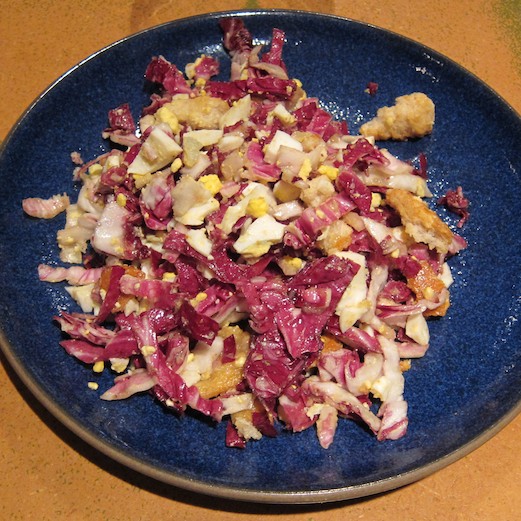
We made a first course of a great salad from the Zuni Cafe CookbookRadicchio with Croutons, Hardboiled Eggs and Anchovy Vinaigrette. It is an excellent salad and easy to make. The recipe is can be found on our blog of: Jan 31, 2007. Click the date to get the recipe.